

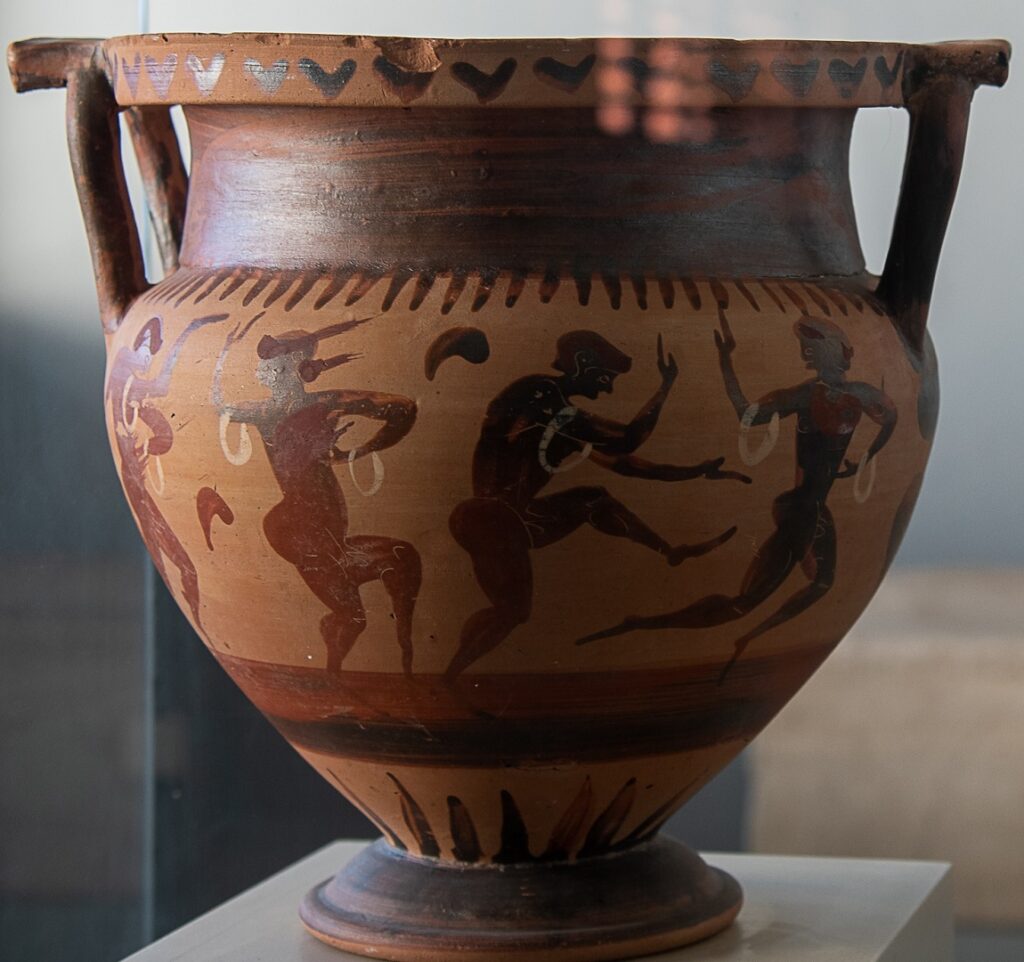
For the first time the city of Serres is mentioned historically by Herodotus as a remarkable city with the name “Siris the Paioniki”.
According to the great ancient historian, Paioniki was built by the Paeonians of Phrygia in Asia Minor and their neighbors, the Odomantes. Both peoples had emigrated before the Trojan War was declared. The ancient name Siris stated that the city of Serres was in ancient times the seat of the bright Sun God, Zeus or Apollo.
Today’s designation could be Ilioupoli and its inhabitants called Heliopaeons. Herodotus comes to verify the above, with his reference to the king of the Persians, Xerxes. Siris, as a center of worship of the Sun god, prompted Xerxes to dedicate his golden chariot to the city during his campaign in Greece. It is a golden sacred and untouched chariot, which was drawn by white horses.
It was dedicated to the Sun god (Apollo or Zeus). This specific chariot during the parades preceded the chariot in which King Xerxes was.
The theater of the Peloponnesian war is transferred to the Thracmacedonian shores by the Spartan general Brasidas. The Lacedaemonian general campaigned in Macedonia to firstly create alliances and secondly to besiege and occupy the cities adjacent to Athens. The Paeonians and the Odomantes sided with the Athenians (who had general Cleon as their leader) and went with them to defend Amphipolis. The two rivals encamped near the walls of Amphipolis, while part of Brasidas’ army remained within the walls of the friendly neighboring city. Brasidas with all his army hid behind the walls of Amphipolis.
Cleon, informed of his opponent’s movements, gave the order to retreat in a marching phalanx. Then the gates of Amphipolis were suddenly opened and the Spartan army poured out from inside, attacking the Athenians in the middle of their phalanx and in its rear guard. The Athenians fled in general and had very heavy losses (600 dead) while only 7 of the Spartans were killed, including Brasidas. Cleonas also fell dead in the battle.
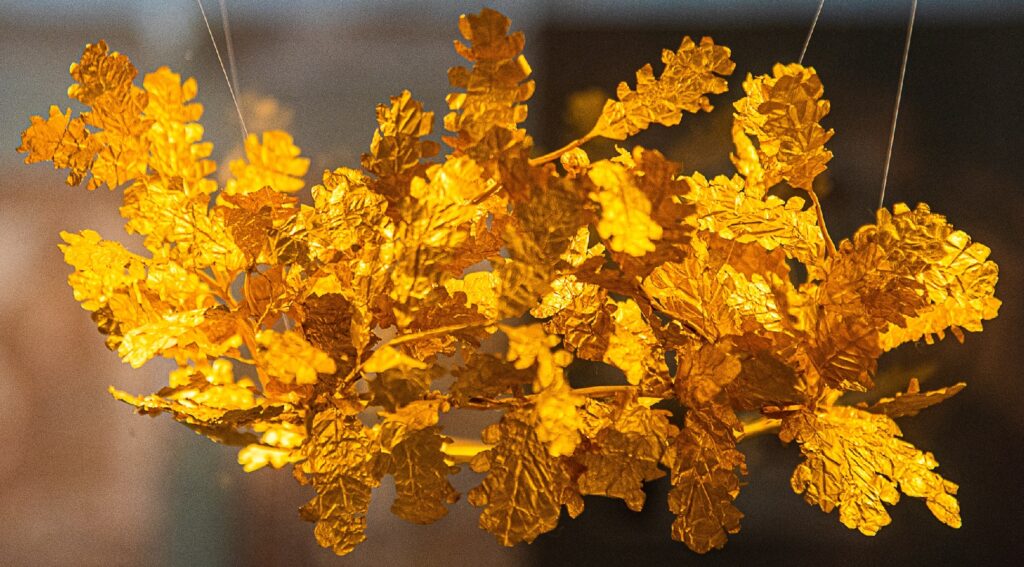
The great defeat of the Athenians and the death of Cleonas and Brasidas resulted in the predominance of peaceful factions between the wars. Thus, in the fall of 422 BC the peace negotiations began which ended in the peace of Nikias in 421 BC. The “tomb of Brasidas” was discovered in recent years and the metal larnax with his bones together with a golden wreath is exhibited in the Archaeological Museum of Amphipolis of Serres.
The tomb was discovered during the excavation work of the plot for the construction of the Archaeological Museum of Amphipolis in 1976. It is a box-shaped tomb made of ashlars, carved into the natural half-rock. It was found unclaimed and sealed. It contained a burial – cremation inside a metal ossuary where a golden wreath of olive leaves was found. The position of the tomb inside the walls leads to the opinion that it is the tomb of a particularly important person who was buried with honors within the enclosure of the walls.
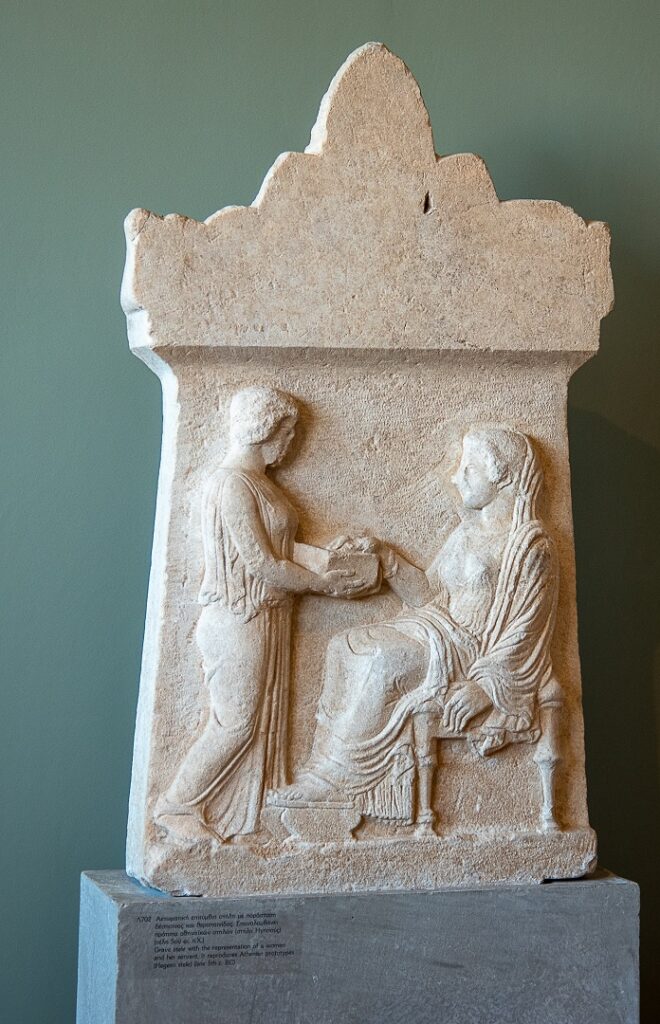
Amphipolis was founded by the Athenians in the time of Pericles, by the Athenian general Agnos, at the mouth of the Strymons, on the site of a city formerly called “Ninea Odoi”, or very close to it. According to Thucydides, the city was named so because the river Strymonas flowed around it, surrounding it.
The position offered her two aspects. One towards the interior, Strymons with the lake of Achinos and ancient Tragilos and the other towards the sea and Iona. At its highest point was the “Acropolis”, which was protected by a wall. The Athenians were interested in gold, the dense forests of Pangaeus and silver. Their success, however, was again short-lived, since at the end of the first decade of the Peloponnesian War (422 BC), Amphipolis seceded from the metropolis of Athens and remained an autonomous city until its incorporation into the Kingdom of Macedonia by Philip II ( 357 BC).
In the northern part of the wall, the largest and most fortified gate of the city (gate C) has been excavated, which led to the bridge over the river Strymons, which was made of wooden piles. A special place in the city was occupied by sanctuaries dedicated to local deities and demons, such as the muse Cleo, the equestrian hero Rhesus, the Nymph, the river Strymonas and above all Artemis Tauropolos. However, the findings also provide important information about the worship of the Olympian Gods, such as the Pythian Apollo, Artemis, Aphrodite, as well as Herakles, the Dioscuri, and Asclepius.
The focus of the religious life of the city was the worship of Artemis Tauropoulos, while in the Hellenistic and Roman years the worship of the Egyptian gods and the eastern deities Cybele and Attios became particularly popular. The numerous finds from the excavations are exhibited in the Archaeological Museum of Amphipolis and the Archaeological Kavala Museum.
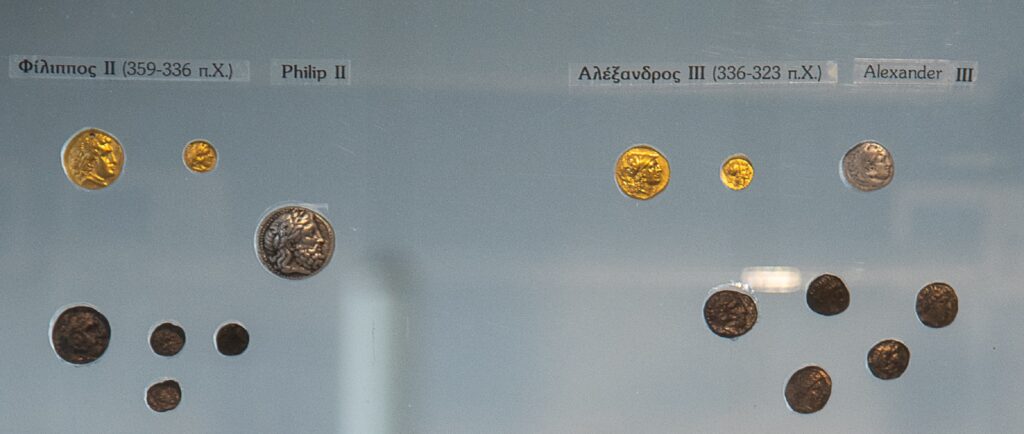
In 357 BC the Macedonian king Philip II captured Amphipolis. The region of Thrace has always been a theater of conflicts between opposing forces. In the period before Philip’s campaigns, however, the situation was quite stable.
Control over most of the region was enjoyed by the kingdom of Odrysas, which had spread during the reign of King Kotyos. His territory reached as far as the region of Hersonissos, in which he even controlled the cities of Kardia and Sestos.
Kotys was murdered in 360 BC. by two citizens of Aenos, Python and Heraklides, who were even honored by the Athenians for this act. After the murder of Kotyos, the kingdom of Odrysas lost its cohesion, as apart from Kersevlept, Koty’s successor, two other rulers emerged, Amadokos and Verisadis, who acquired independent territories in the area of the divided kingdom. This situation was beneficial for the other interested party, especially in the area of the peninsula, Athens. The Athenians had traditional ties to the region of Thrace, which they had systematically colonized since the time of Pericles, and were in open conflict with both Coty and Kersevleptis, who with the help of mercenary leaders repelled the Athenian attempts at conquest. of Hersonissos. The Athenians therefore used the visions of Verisades and Amadokus to thwart the expansionist visions of Kersevleptos.
The conflicts seemingly came to an end with the signing of the Treaty of Charitos in 357 BC. However, Kersevleptis systematically violated the treaty by demanding duties from the Athenian ports and customs, while from 357 BC. the famous allied war broke out which led to the collapse of the Second Athenian Alliance and the weakening of Athens. Then Philip, king of the Macedonians, took the opportunity and took the first step towards the conquest of Thrace by capturing Krinides, which took place in the year 357/6 BC.
The invitation of the Krinides, a colony of Thassos, which was located in the northern part of the gold-rich Pangaean mountain, gave Philip the opportunity he had hoped for to spread further east. The Krinides were facing the aggression of Thracian races, possibly the children of Berisades (he himself had died the previous year), and they fled to Philip for protection. Philip, after successful wars, occupied the area, rebuilt the city, installed new settlers and renamed the Krinides Philippi, giving the city his name. The rich deposits of Pangaeus – which according to scholars exceeded 1000 talents per year – redefined Philip’s policy and broadened his goals.
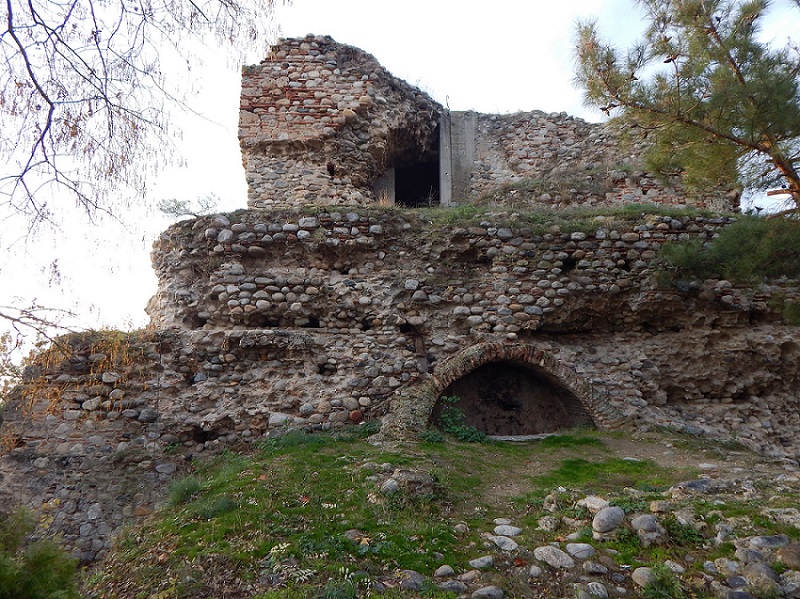
This occupation, however, activated the reflexes of the neighboring rulers, who immediately began negotiations for the creation of an alliance, with the objective of subduing the villages occupied by Philip and expelling him from the Krinides.
In this tripartite alliance, which with the addition of Athens became a quadripartite, took part the ruler of the Odrysas Ketriporis (the successor of Verisades) and his brothers, the ruler of the Paeonians Lyppeios and the leader of the Illyrians Grabus.
But Philip did not passively wait for the attack of the alliance, but took the initiative of the movements and with aggressive action managed to defeat the opposing coalition. Thus the area of Odrysas held by Ketriporis and his brothers became a vassal kingdom of Philip and Nestos became the boundary of the new extended Macedonian territory.
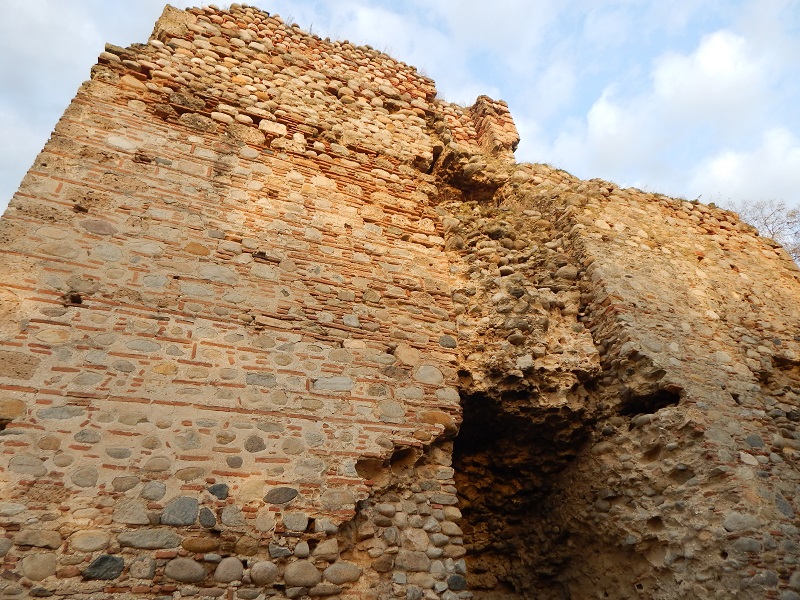
Ioannis Tsimiskis did not take strict measures of military occupation in a part of western Bulgaria, and the family of voivode Turnovo Nikolaos Sisman with its four children, the so-called Komitopoulos, found the opportunity to prepare a rebellion. Sisman with his four sons, David, Moses, Aaron and Samuel, claimed the Bulgarian throne. The children of the deceased in January 969 AD. King Peter, Boris II and Romanos, were political prisoners in Constantinople.
The Byzantines left in 976 AD. the legitimate heirs, Vori and Romanos, to escape to organize a resistance movement against the claimants to the throne. Unfortunately, on the way back, Boris II was killed by a Bulgarian guard who mistook him. Romanus lost the throne and joined the Sisman family. The voivode of Turnovo Sisman together with his four sons took advantage of the attitude of general Vardas Skliros, rebelled in Bulgaria and upset the entire Byzantine Empire.
Of the four sons of Shishman, David was killed at the beginning of his action. In the spring of 976 AD Moses marched with a large army into Macedonia and closely besieged the city of Serres. The city resisted because it was very well fortified. Its defender was Duke Melissinos.
The siege lasted a few months. We do not know in detail what took place around the walls. The only thing that Kedrinos informs us is that while Moses was roaming around the walls of the besieged city of Serres “he was thrown from the wall by a stone”, meaning he was hit and killed with a stone thrown by the defenders from the walls. Others say that while riding his horse around the city walls he fell from the horse and was killed. After his death his army lifted the siege and fled. The city of Serres was temporarily freed from the enemy.
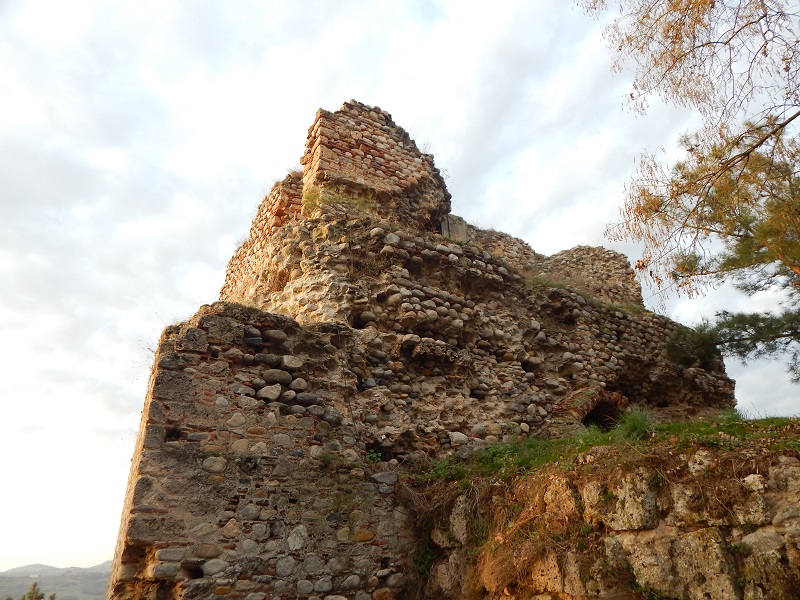
The war between Samuel and the emperor Vasillio II was adamant, long, stubborn and destructive, because it was a war of life and death. Taking advantage of the positions of two Byzantine generals, Scleros and Vardas Phokas, Samuel began the war.
The Bulgarians turned their liberating struggle into a conquering one, aiming to occupy the entire Balkan peninsula. Starting first at Prespa and then at Achrid, Samuel occupied western Macedonia, Epirus and then the whole area between the Danube and Aemos. He made Ahrida his capital and re-established the Bulgarian Patriarchate, which had previously been abolished by Ioannis Tsimiskis. He extended his state from the Black Sea to the Adriatic and from the Aimos to Thessaly.
In 980 AD Samuel turned south. During his march, he attacked the city of Serres. He was not able to conquer it, because it was very well fortified and excellently organized. The fortification of the city thwarted the plans of the conqueror. In his wake, the region of the prefecture of Serres was once again plundered. He assaulted Thessalonica unsuccessfully and besieged Larissa very closely. He also threatened the Peloponnese, advancing with plunder and destruction as far as Corinth. When Samuel learned that Emperor Basil II had invaded Bulgaria from the Rhodope straits heading with his army towards Sofia, he took the way back. The emperor hastily returned to Constantinople because there was a revolution against him.
During his retreat the Bulgarians ambushed him. After difficulty he was rescued in Philippopolis in August 986 AD. Fortunately he was released in 990 AD. from the internal positions and resumed the campaign against the Bulgarians from Thrace and Macedonia. For the first time he came to Serres and fortified the city to withstand any enemy attack. It strengthened its walls with strong towers. He fortified the city of Serres to have it as a base in the campaigns against Samuel.
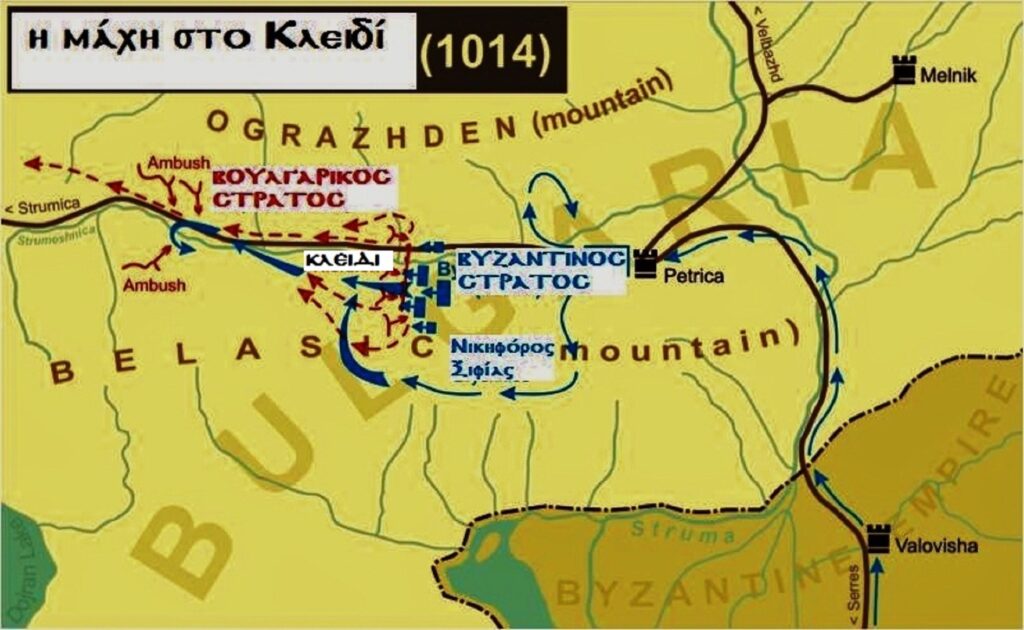
Samuel started the stealth war again in 1014 AD. setting up ambushes in narrow paths. He avoided fighting with Basil II, even though the latter annoyed him by invading Bulgaria every year, setting out from Serres. Kedrinos writes: “and the king did not pass each one of them in Bulgaria and in some measure both” (that is: the emperor Basil II did not fail to invade Bulgaria every year, destroying and cutting everything he met on the way of plundering the land of Samuel). They both stubbornly persisted in this long and destructive war. It was a life and death war between the two states.
Samuel made it his goal to remove the lands of Europe from Byzantium. He would certainly have done it, if Basil II had not been emperor at that time. Samuel decided to strike Basil II for the last time at the Key, in 1014 AD. He built a wall in the strait of Strymonas, at the Key of Sidirokastro. It blocked the passage of Basil to the north with an army of 15,000 plus well fortified behind the wall and the surrounding heights.
To create a distraction for the Byzantine army, he sent men with general David Nestoritsis from the mountains of Doirani to Thessaloniki. The general of Thessalonica Theophylaktos Botaniatis defeated the Bulgarians and put them to flight. He advanced and joined the rest of the Byzantine army. Together they tried to raid the straits of Strymons. The Bulgarians were well fortified behind the wall, and from the surrounding heights decimated the Byzantine army.
The months passed and the emperor grew hungry. He despaired day by day. According to Kedrinos, the general Nikiforos Xifias was patrolling Mount Valathista south of Kleidi with an army squadron and from a difficult path in the area of Aggistro found himself on July 29, 1014 in the south of the defending Bulgarians. The Bulgarians were surprised by the unexpected encirclement and panicked when they found themselves between the two divisions of the Byzantine army, being pushed at the same time by the emperor Basileus and the general Xiphia. They fled. Several were massacred and many were captured. Samuel was saved from captivity with great difficulty. He managed, with the help of his son, to get on a horse and take refuge in the fortress of Prilapos, in Perlep
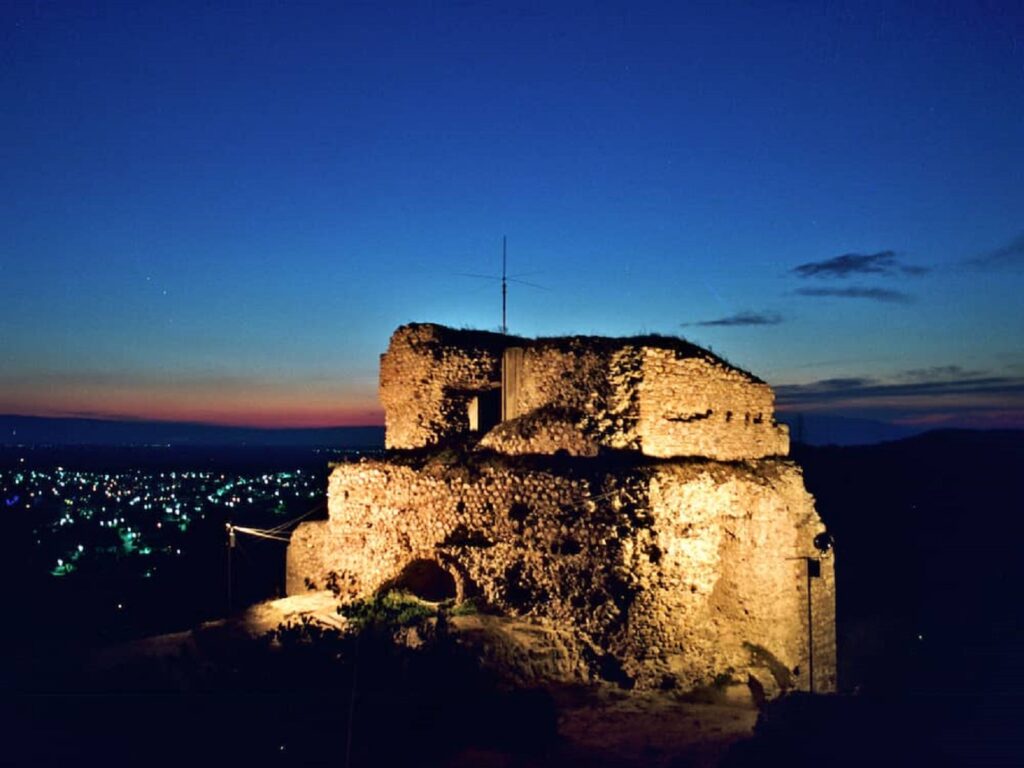
Even before the Franks captured the city, they divided the Byzantine Empire between them. They determined in advance where they would give the offices. Candidates for the Byzantine throne were Boniface the Momferatikos and Baldwin, Count of Flanders, but with the intervention of the Doge of Venice Dandolo, Baldwin was elected the first Frankish emperor of Constantinople. Boniface was given Asia Minor as a share, but he did not accept it. He wanted to become king in the second city of the Byzantine state, Thessaloniki, with all of Macedonia, which he considered to belong to his family because Manuel I Komnenos had given it as a dowry to his daughter Maria who married Boniface’s brother, Rainier .
Baldwin did not accept the exchange of the area of Thessaloniki and therefore, pursuing the fugitive Byzantine emperor Alexios III Angelos, he passed through Serres and subdued Thessaloniki. Boniface regarded this as an invasion of his fiefdom, and took up arms with the intention of striking a blow with Baldwin. The crusaders intervened and referred the matter to the judgment of the Council of Comets and Barons, who vindicated him and Boniface was officially crowned king of the state of Thessalonica, which included today’s Central and Eastern Macedonia and part of Western Thrace up to Mossinopolis.
Boniface, leaving Margarita as commissioner of authority in Thessalonica and having with him his ancestor Manuel Angelos, passing through Serres in 1208 AD with many knights and rulers, attempted to occupy the area that was given to his state. He occupied the cities without resistance because he behaved very diplomatically with great sympathy and secularism towards the Greeks. He was liked by the Greeks because of his affinity with the Byzantine imperial family. They considered him their own compared to the other Latins. Boniface installed a strong Latin garrison at Serres of skilled warriors. He left his marshal, the noble William de Onois, and the perfect knight Hugo de Coligny as leaders, and a great multitude of his best followers. The example of Serres was imitated by other cities in the regions of Thessaloniki and eastern Greece. They received the noble marquis without a fight.
Frankish writers refer to Serres with a distorted name, as Sarra, Serra or Serta.

After the destruction of Theodore Duke Angelos at Klokotnitsa in Bulgaria (see Haskovo), the tsar of the Bulgarians Asan, taking advantage of his victory, advanced into Thrace and Macedonia and occupied within a few months all the cities that Theodore had liberated from the Franks, namely Adrianople, Didymoteicho, Xanthi, Ahrida, Prilapos and Serres. Thus the city of Serres again fell into the hands of the Bulgarians, but without causing any damage.
Asan was a moderate ruler and struggled in every way to curry favor with the Greeks. The kingdom of Thessalonica did not mind, because the younger brother of Theodore, Manuel, the son-in-law of Asan’s daughter, was declared emperor in it.
Theodore ruled from 1230 to 1237 AD. as a vassal sometimes of Asan and sometimes of John Vatatzis, emperor of Nicaea.
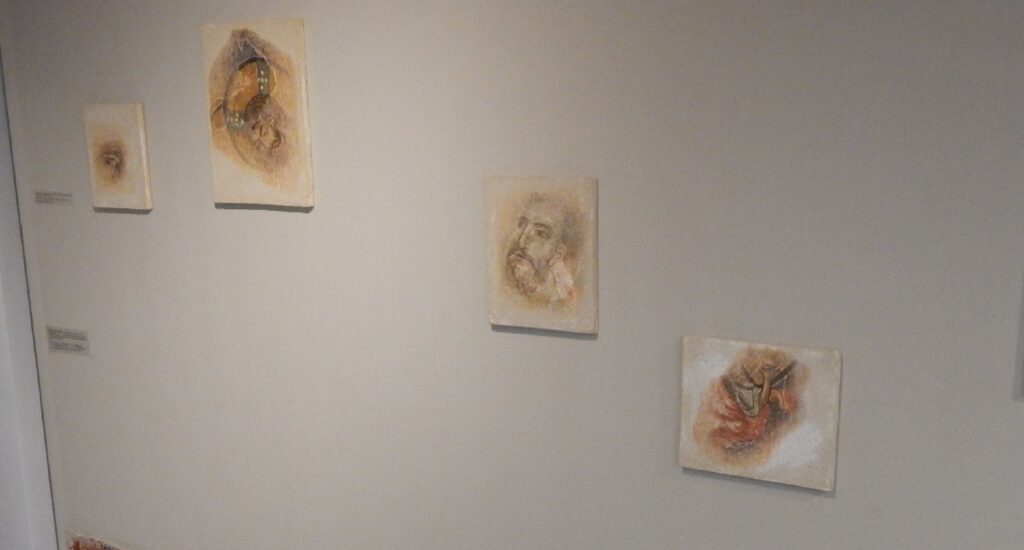
The great domestic Andronikos Palaiologos advised the emperor in 1230 AD to try to conquer the city of Serres. He argued that if they captured it they would have a big cedar: they would humiliate the Bulgarians and force them to send ambassadors to reconcile and ask for peace, as they were ruled by the minor Michael. The king adopted his advice and immediately left Philippi for Serres. He arrived there and camped on a hill outside the city, possibly Maroulis Hill above the Monastery of Saint George. He did not have an army worthy of battle with him and that is why he was trying to conquer the city with strategies and diplomacy.
The city of Serres was once very large, but Voulgaros Ioannitsis in 1206 AD. he had besieged it and reduced it to ruins, like many other Macedonian cities. Varosi was then like a village. Only the Acropolis was walled and prepared to face war. Its guard was the Bulgarian Dragotas. The lower city was without walls, because Ioannitsis tore them down. Only the unlimed stones were piled two meters high, as roughly as a pen. Emperor Vatatzis immediately summoned the mercenary soldiers who accompanied him. They were called tsulukones, that is, a mob of lower social status. In a way he provoked them to take over the city. When they saw the lower city without walls they considered it an easy prey and proposed to march against it themselves. Food was scarce among them, and it was absolutely necessary to attack immediately to procure the necessities of life. That is why they immediately grabbed their bows, swords and with improvised wooden shields rushed towards the city of Serres shouting war cries.
Serres did not have many inhabitants then, because most of them had been captured and slaughtered by Ioannitsis. The Bulgarian soldiers who lived in it were easily defeated. Some of them reached and climbed the Acropolis and others went outside the city and fell at the feet of the emperor Vatatzes. The Bulgarian guard of the Acropolis Dragotas, when he saw that the lower city was captured and only the Acropolis remained, because he was informed of the death of the twelve-year-old king of Bulgaria Kaliman and had no experience in guarding fortresses, therefore without delay he sent ambassadors to surrender the Acropolis to the Byzantine emperor. The Greeks of Serres joyfully hailed King Vatatzis. The king honored Dragotas who handed over the city to him. He gave him enough money and clothed him in gold-woven cloth

The Holy Prodromou Monastery was built in 1270 AD. and despite the successive disasters it is today a monument and Museum of Byzantine Art of amazing beauty. The first founder of the Monastery was Ioannikios who was also bishop of Ezevo.
The substantial expansion of the Church was done around 1300 by the nephew of Ioannikios, Joachim, bishop of Zichna, who built the Catholic Church that is preserved to this day, as well as the Table for the monks’ meals and high walls covering the entire area of the Monastery.
He took over the tax office of the Monastery in 1332 AD. the commander-in-chief Domestichos and later Emperor John Kantakouzenos.
In that period, the Monastery was declared Sauropigian and patriarchal by imperial decree. In 1345 the Monastery suffered great damage from the invasion of the Serbs and thanks to Eleni, wife of the Serbian King Stefanos Dusan, it escaped total destruction. In 1353, by her own initiative, the monastery of Saint Anastasia and Panagia Ostrini was added to the Monastery of Monhydri.
In 1371, before the final occupation of Serres by the Turks, the monks obtained from Murat the first sultanic firman, by which the Monastery was exempted from the land tax.
From 1457 to 1462, the first monk after the fall of Constantinople, Patriarch Gennadios the Scholar, stayed in the Monastery until his death. he was buried at Midnight near the tombs of the two Founders. In 1854, his remains were collected, which are kept in a special ark until today. In the middle of the 18th century, due to a lack of financial resources, the monks abandoned communal life and adopted the peculiar system.
A serious blow to the Monastery was the looting of its library in July 1917 by the Bulgarians, who together with the captured monks sent to Bulgaria 24 Gospels, 200 rare manuscripts on paper, 1500 old books, 100 volumes of manuscripts on film, four gold coins of Byzantine Emperors, five patriarchal sigils and many other precious sacred objects. With the treaty of Neuilly, some manuscripts were returned and are probably in the National Library of Athens, while the greater number of them remain in Sofia.
These precious objects were kept in the library of the Monastery in the Tower of the SW corner of the wall, which surrounds the monastery.
The central temple of the Monastery is preserved in stone and consists of the Ninth, the Midnight and the Catholic along with the Holy Vima. the Church is a monument of Byzantine Hagiography, the frescoes of which at Midnight are attributed to the Macedonian Hagiographer Panselinos. The oldest are those made during the Abbotship of the second founder Joachim and are distinguished by their expressiveness, realism and passivity.
The iconostasis is wood-carved and dates to 1804. On the right and left are hung the images of Christ Pantocrator and Panagia Odegetria that come from the original iconostasis of the catholicon and together with the first layer of frescoes of Enati represent the art of the heyday of the Paleologues.
Thousands of people visit the Monastery which is a treasure of untold artistic and historical value. Since 1986, a women’s sisterhood has been installed.
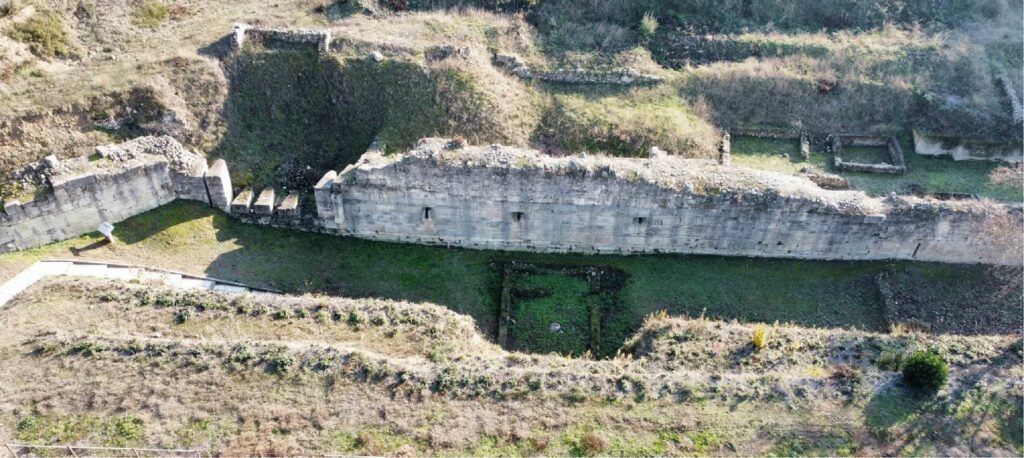
In the fall of 1342 AD Cantacouzenus set out with his army from Serbia for the Didymoteichos, which was commanded by the wife and son-in-law of Asan. He was also accompanied by the king of Serbia, Dušan, to Serres, which was still resisting. Kantakousinos and Dusan wanted to force the inhabitants to surrender the city. Dusan of Serbia as an ally of Cantacuzenus, before damaging the region, sent ambassadors to the Serrai and advised them to surrender the city to Cantacuzenus. If they acceded he would himself become their friend and ally, while he would be the enemy of those cities which would prefer to fight him. These oaths of alliance were given to each other by Dusan and Kantakousinos. If the people of Serres were convinced and willingly joined Kantakouzenos by surrendering the city, they would leave Serres as soon as possible for Didymoteicho. They promised them that they would not be harmed. But if they seemed ignorant, he threatened them that he would cut down all the trees in the area and cause them great destruction.
The Serrai expelled the king’s embassy and said that because of their enmity towards Cantacouzenus they preferred to suffer everything rather than surrender the city. In this refusal, they were motivated by the relative of the Palaiologos, the commander of the city, Konstantinos Palaiologos. They declared an open war against Kantakousinos without any reason. Cantacouzenos, sensing the great destruction that would befall the beautiful city of Serres because of their insensitivity, sent his own representative to beg them to pity themselves. Let them not suffer incurable afflictions, because of their hatred of him, but take care of themselves. He begged them with his sent ambassador to be persuaded. He preferred that he and his guard not be received in the city, but that he be commemorated in the sacred ceremonies third in line, after the queen mother Anna Palaiologina and her son John V, as emperor. They would be freed from the siege and its miseries. The Serbs, according to the oaths of the alliance, would do them no harm and injustice. He himself would leave to capture Constantinople. If they remained with the Paleologues, they had to hold the siege defense without food. He advised them to think logically, with prudence and understanding to avoid the miseries of war. They began to curse the envoy and hurl many accusations against Cantakuzenus, saying that he should think about himself and his people and not themselves. Kandakouzinos and his followers were in great perplexity. They decided together not to linger any longer in Serres, but to leave for Didymoteicho as soon as possible in order to achieve something better. Kantakouzenos agreed with Stefanos Dusan and left taking the army he granted him. Dušan remained with the rest of the Serbian army in Serres and besieged it. He cut down the trees of the plain destroying everything in the area of Serres.
Stefanos Dusan did not take long to show his insidious purposes. In fact he did not want to help one of the warring factions, Cantacouzenus or Palaiologos, but only to take advantage of the Byzantine civil war to seize territory from them. Kantakuzinos with 20,000 cavalry was outside Kavala and with the Seljuk Umur was asking Stefanos Dusan to abandon the siege of Serres. They unexpectedly learned that on June 11, 1345 AD. the grand duke Alexios Apokaykos, the cause of all calamities and evils, was murdered by prisoners in Constantinople. At Umur’s urging, they left Serres and went as quickly as possible to Constantinople to take advantage of the new situation. Unmolested, Dusan continued the long siege of Serres. Kantakouzenos did not want the Macedonian cities to be handed over to the Serbs, but because of his preoccupation with many other problems he could not defend them.
All of Macedonia up to Kavala, except Thessaloniki, was enslaved to the king of Serbia. During the siege of Serres, Dusan destroyed the entire region. He cut down all the trees and made everything desolate. However, when he captured the city, he did not destroy it, like Ioannitsis. He forbade the massacres and looting of the invading Serbian soldiers. He tried to curry favor with the residents. It is possible that this was one of the terms of the surrender of the city, since the surrender was due to hunger and great need. He entered the city on Saturday at nine o’clock in the morning. The next day, Sunday, he went to church in the old metropolis of Aghii Theodori and began to be friendly. He recognized the property of the monasteries by issuing golden decrees to secure it
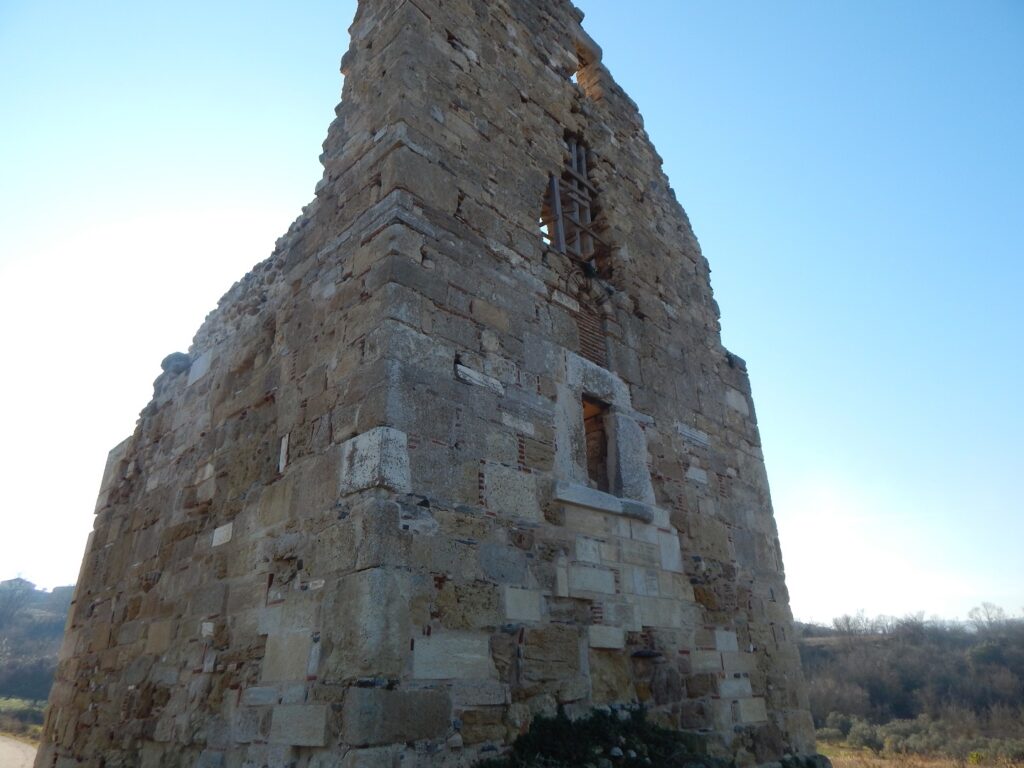
Ioannis Ouglesis and his brother Vukasin were killed on September 26, 1371 in Evros by the Turks, in the battle of Tsirmen. The state of Dusan and his successors became tributary to the Turks. However, Serres was liberated by the despot of Thessaloniki, Manuel Palaiologos, and came under the rule of Byzantium. The few Serbs who remained in Serres accepted the cooperation of Manuel II. The city of Serres returned to the Byzantines without siege and bloodshed. Manuel did not bring about changes in Serres in terms of administration, because everyone preferred the Greek restoration to the Turkish occupation. Recapturing Serres from the Serbs, he made sure to fortify the dangerous parts of the Acropolis on the northern side, from where it was vulnerable. Repair or build three towers. Serres was then the biggest bastion towards the east against the Turks. The same fortification was done by Manuel II in other fortresses, trying to positively organize the resistance against the Turks. Manuel II’s authority at that time started from Nestos and reached Vermio, including Veria.
The situation of the Byzantine state was desperate. From the long civil wars the state was completely weakened. The Turks settled permanently on the peninsula of Gallipoli, fortified it and watched over the peninsula of Aemos, the Balkans and the whole of Europe. The Balkan peoples were unable to unite to face the common enemy. They were exhausted by long wars and internal, social and political upheavals.
The Turks, however, were furious that a Byzantine prince was found to oppose them. The Chets dispersed in eastern and western Macedonia and continued their plundering and destruction. They did not occupy the castles projecting resistance, such as e.g. of Serres. They bypassed them and proceeded only to plunder Macedonia.
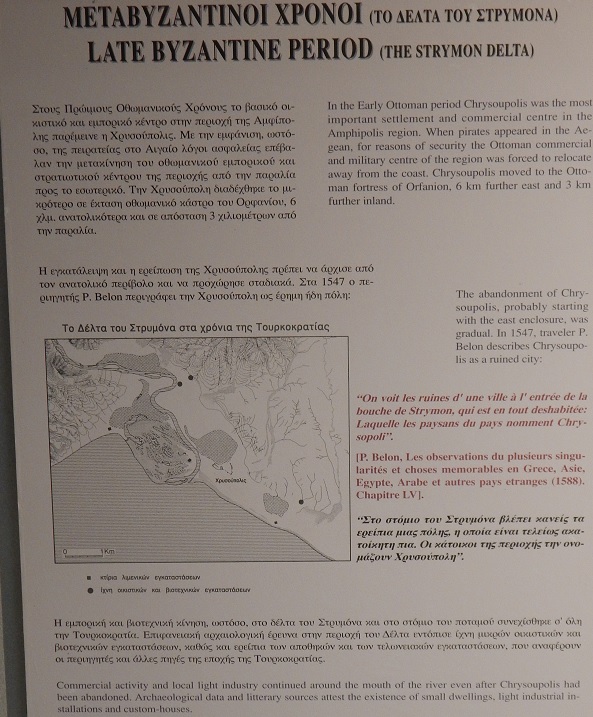
The Ottoman Empire occupied the city of Serres and included it in its buildings until 1913. The period of Turkish rule begins in the prefecture of Serres with the occupation of the city by the Turks. The events of the capture of the city are recounted by the Turkish historian Seateddin Muhammed, who wrote the “Crown of Stories”.
Sultan Murat I ordered the commanders of Andrianoupolis and Prussia, Lalasiachin and Evreno Bey, to occupy Thrace and Macedonia with the help of Hairedin. The first to besiege Serres was the Turkish general Delio Bebas Beys but he was unable to capture it with his own troops. Then general Lalasiahin came to add his own army, but again it was impossible. To them was finally added the general Evrenos Beys with his own troops. Serres was very suffocatingly besieged by the Turkish troops for eight months.
The impregnable fortress of eastern Macedonia was pressed by a lack of food without any hope of salvation. Until on September 19, 1383, Serres surrendered to the Turks after they first imposed some conditions on them which they accepted. After the conquest, Sultan Murat I himself came to the city, stayed for several days and founded the first Turkish Eski Mosque which was preserved until the first decades of the 20th century and was located next to Bezesteni, the current archaeological museum that was built and this almost at the same time. Also, the Turks then demolished the wall and the strong castle of Serres in order not to become a center of resistance in case the enslaved Greeks rebelled
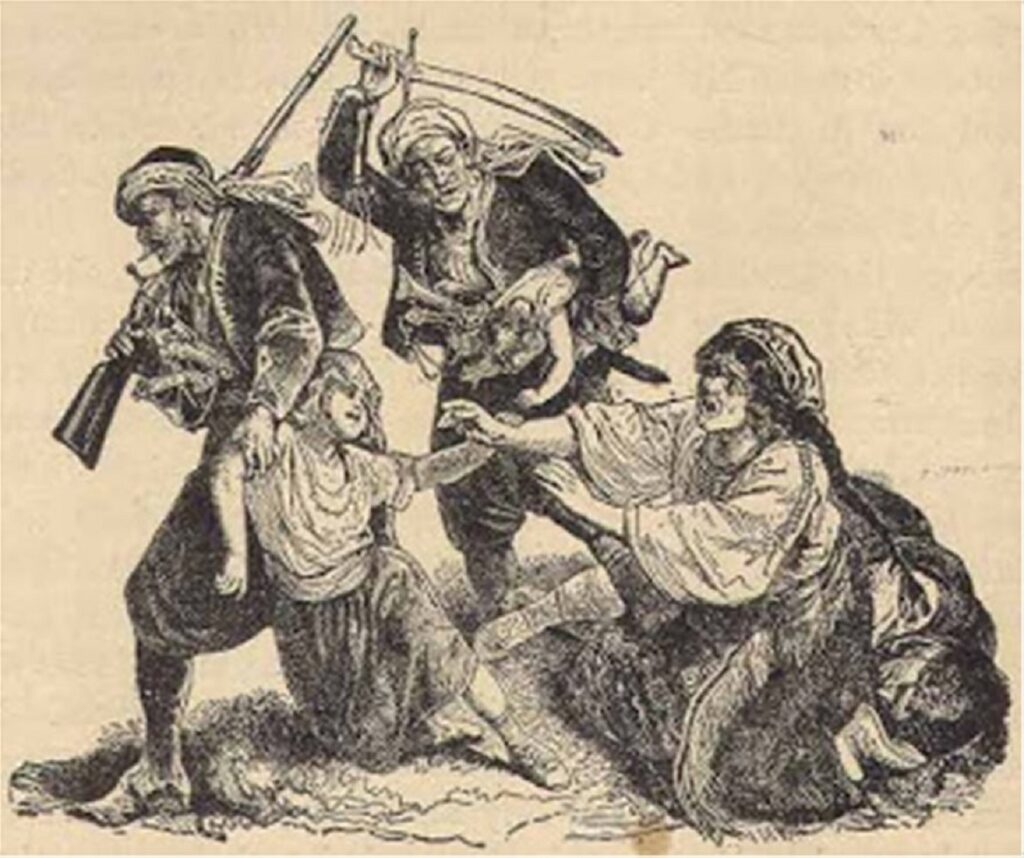
After the fall of Constantinople, the position of enslaved Christians continued to deteriorate. The Turks violated the privileges they gave and tried in every way to forcibly convert the Christians to Islam. The most terrible of all was the pedomazoma, which at first took place every five years and they took 1/6 of the young children from 7 years old and older. Then they started every four years, every three years and finally they collected children from the Christians every year. Wailing and wailing were made every year when they came to Serres to snatch the innocent Christian children from their mother’s arms. Because the Turkish army was impertinent, undisciplined and insubordinate, diverted to much debauchery and disorder, Kara Khalil Tsenterli thought of taking advantage of the advantages of the Greeks. He formed a new army of Christian children who converted to Islam after child molestation. They took by force from Christian families the best boys at the age of 7 years, before the feeling of religion, family, country was established in them, and after cutting them off from all previous ties to country, religion and family, they turned them into murderers of their parents and unsparing enemies of Christianity and Greece. This new army of the Turks (the Janissaries) was formed by fifteen-year-old Christian children converted to Islam. They practiced deprivation, austerity and above all strict discipline. They always lived in the barracks, did not marry and had as ideals to eat, drink and enjoy everything and also to always hold up the red crescent flag.
The rich bought their child’s freedom for 60 or 70 gold coins. Many families sold their entire property in order to redeem their children from the pedomazoma. Of the chosen children, those left over were sold as slaves.
The Turkish chronicler Evlias Tzelebi reports that every seven years the leader of the janissaries accompanied by 500 or 600 janissaries forcibly recruited from the Balkans, Greece, Bulgaria and Serbia, 7,000 to 8,000 Christian children.
For the first time in March 1622, at the time of Sultan Mustafa, Bairam Pasha came to Serres for child-rearing and took 6 children, while on December 23, 1637, the slave Dervish Agas came and took 5 children from Serres. According to the law, he was supposed to take from the inhabitants of Serres as many white coins as were needed for the shave, for the red cap and for the red (emba) clothing of the conscripts, but it seems that, in violation of the law, he also took on his own behalf 220 white Turkish coins. When Sultan Murat found out he beheaded him for his illegality. Many Greeks, to avoid child molestation, betrothed their children in a church ceremony from the age of 8, 9 and 10
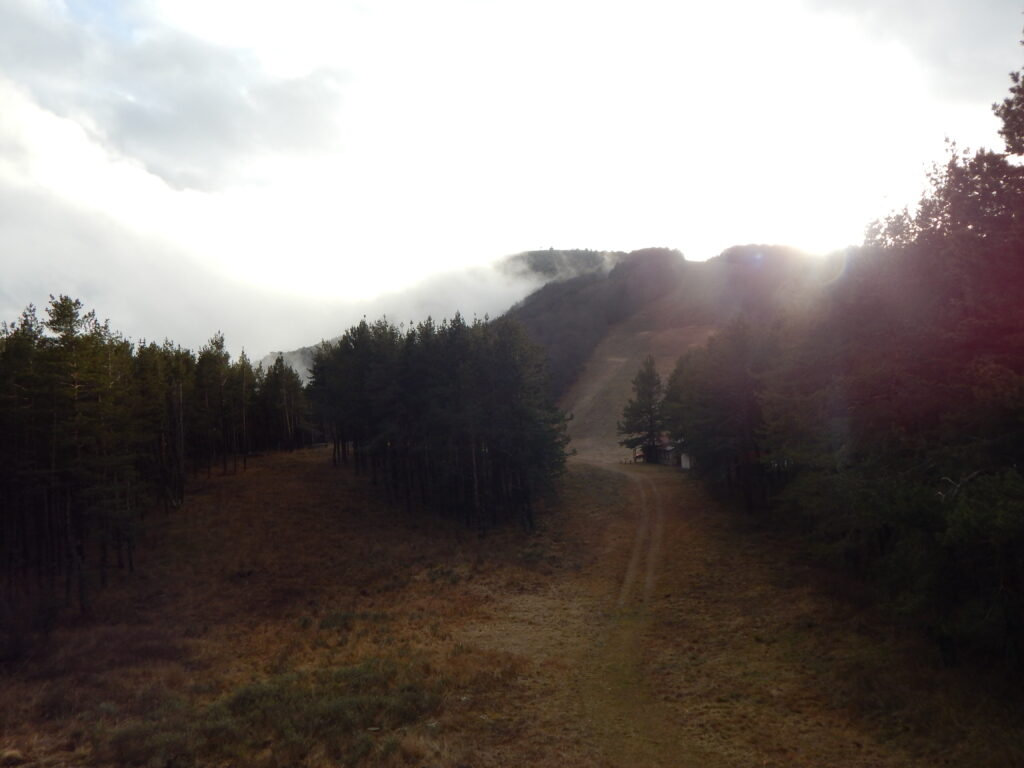
The enchanting beauty of Lailia has been extolled since 1668 by the Turkish traveler Evlias Tselebis, who devotes an entire chapter to the “Praise of the great resort of Serres” in his travel book. “This resort,” he writes, “is famous throughout Rumeli, Arabia and Persia.” It is a place with a brilliant climate, a true warm-hearted paradise, superior to which there is none. In this resort, people need an overcoat in the summer, because sometimes it snows and the cold is harsher than the winter.”
During the Turkish era, two thousand prefects of the Nomos had summer residences in Lailia, and the Peides sent their harems there to spend their holidays. There were then about 40 mosques, inns, many monasteries, schools and thousands of other various buildings, i.e. a whole city. A little later, the Serrai people created a picturesque village in Lailia, thus making it a valuable resort. The slopes of the peaks of Lailia, covered by beech and mountain pine forests (code GR 1260007 in the NATURA 2000 program), offer the forest visitor opportunities for hunting, camping, winter sports, photography, painting, nature study, climbing, mountain biking and hiking on the walking trail E6. Almost in the center of Lailia is Sfagnonas Balta Tsair, a paleobotanical site of great importance for the study of the history of the forest. Sfagnonas has been declared a “Preservable Natural Monument” and an area of “Particular Natural Beauty”. In this watery area, with its rich vegetation, there are leisure facilities for visitors.
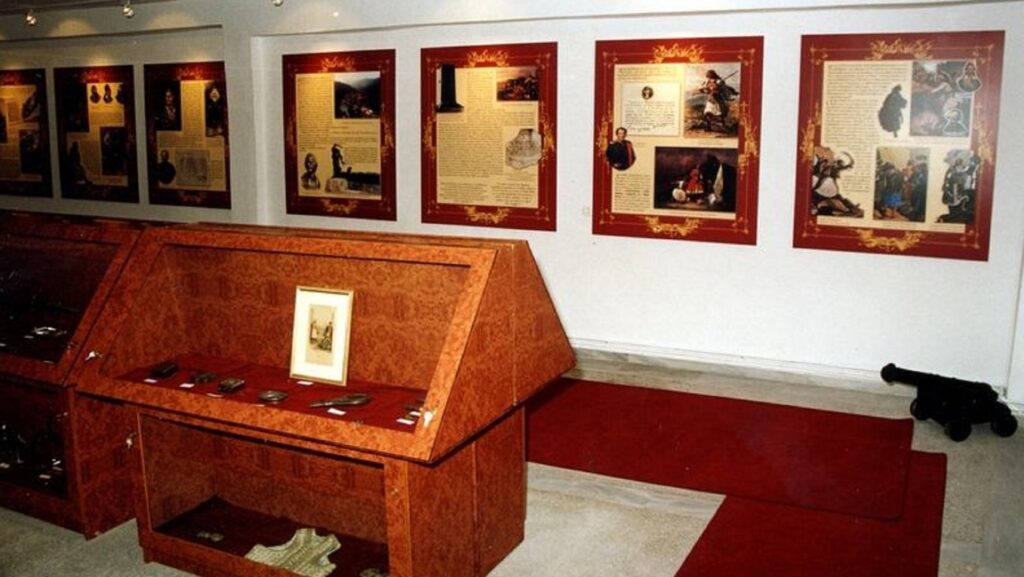
When the revolution broke out in 1821, on March 25, Emmanuel Pap(p)as from Mount Athos and Nikolaos Kasomoulis, called the people of Serra to rise up. In the city of Serres, Nik. Kasomoulis and his fighters fortified themselves in the Monastery of Panagia tis Liokali in the Katakonozii district. But the movement was betrayed. Kasomoulis was forced with his men to withdraw. Serres took the lead in the Revolution of 1821. Emmanuel Papas, Metropolitan Chrysanthos and many merchants, scholars and dignitaries were initiated into the Friendly Society by Yiannis Farmakis from 1818 onwards. With the initiative of Metropolitan Chrysanthos and Emmanuel Papas, Serres became the most fiery center of the Greek Revolution of 1821 in Macedonia. Everyone was struggling to prepare the revolution in Serres. About 1,500 war veteran charioteers and thieves from Olympus were private in Serres. With them they fortified the Monastery of Prodromos and the Metochi of Panagia Iliokali. They were waiting for the signal to start the revolution.
However, the hanging of Patriarch V and the presence of a strong force of the Turkish army in Serres restrained the enthusiasm. Led by Giannis Kasamoulis, they fortified the monastery of Panagia Iliokali east of Serres. Emmanuel Papas was forced to flee to Constantinople to avoid the conspiracy of the Turks who owed him. Metropolitan Chrysanthos of Serres, when Yusuf Bey imprisoned his family, took care of her and later saw to it that her death sentence was commuted to life
On May 7, 1821, Greek ships, probably from Psara and possibly on the orders of Emm. Papa’s staff (having information about the quantity of gunpowder that was transported and stored in the customs office of Chaiezi, intended for the Serras and for the rebellion of the Serras) attack in the port of Amphipolis with the main aim of grabbing it (perhaps they also took other material that was in the Customs, such as food). The Turks of the surrounding villages, however, were ready and came down to the beach in their chariots to take up positions. The massacre of the Serrai would take place in revenge for the leader of the revolution of Halkidiki, Serrai Emmanuel Papas.
They first had to disarm the Greeks who had weapons in order to slaughter them without resistance. The date of the massacre was fixed and Mehmet Bey notified his friend Papaioanni Sakellario in time to go to their house to save himself. Papaioannis informed the Metropolitan of Serres immediately. The metropolis notified the Greeks to shut themselves in their homes. The metropolitan ran on horseback to the command post, courageously protesting to the kaimakamis about the plan to massacre the Greeks by the fanatical Turks. His dynamic integrated personality exerted a great influence on the Turkish authorities. He acted swiftly to stop the slaughter. A mounted gendarmerie unit led by the kaimakamis and metropolitan Chrysanthos went to the market and with threats of execution on the spot of the unruly, dispersed the groups. His bold intervention saved the population of the city of Serres from certain slaughter. Only four people were slaughtered, two girls and two men
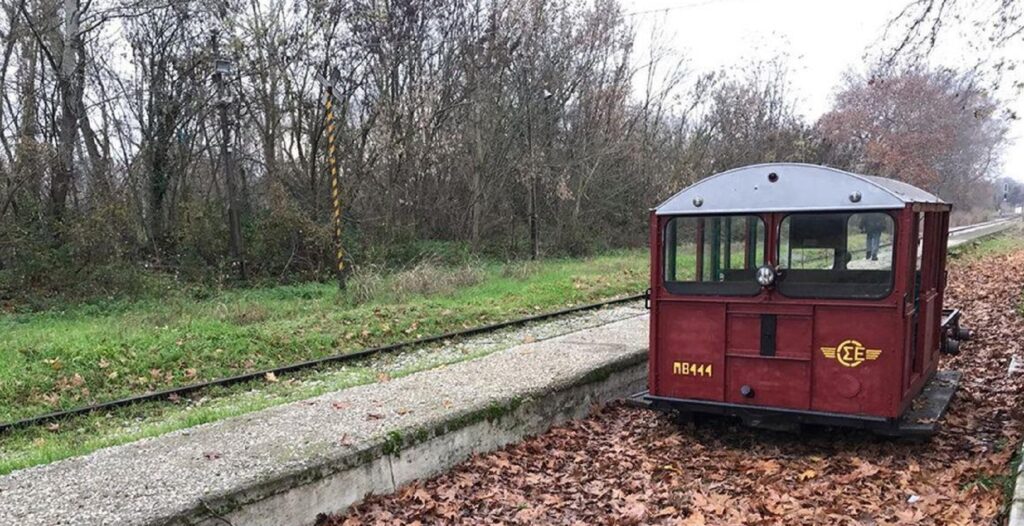
The railway connection between Thessaloniki and Istanbul was completed, including the city of Serres in its layout. In April 1869 the sultan granted a group of Austrian interests permission to build 1,500 miles of Balkan lines from the Austrian border to Nis, Sofia, Adrianople and Constantinople. This line, investment of the Austrian Hirs, was completed between 1872 and 1888.
In the decade 187-1881, Thessaloniki was connected by rail to Belgrade, a line costing 50,000,000 gold francs.
Baron Hirsch commissioned Italy’s Bariola to complete the project. There were many anti-Semitic cries in the German-speaking world against the connection of Thessaloniki in particular. However, the work was done overcoming even the destruction caused by the floods of the French River.
In 1892, the Thessaloniki – Monastir line was built with German funds under the name Salonique – Monastir (S.M) under the management of the Eastern Railway Company (C.O.). Today, this line in Greek territory is called the Thessaloniki – Florina (T-F) line. From 1893 to 1896 the connecting line between Thessaloniki and Constantinople was built by the company JONCTION SALONIQUE CONSTANINOPLE (JSC). The contract, signed in the spring of 1892, granted the French banker Baudouy the largest mileage subsidy of the time: 15,500 francs a year for 99 years of exploitation.
Later, smaller supplementary layers were made to complete the current form of the line Thessaloniki – Alexandroupoli (T-A) and Alexandroupoli – Ormeni (A-O). Since then, these lines have been the main and almost exclusive network of the Macedonian-Thracian railways with minor modifications, in terms of the original layout and with minor extensions of main lines.
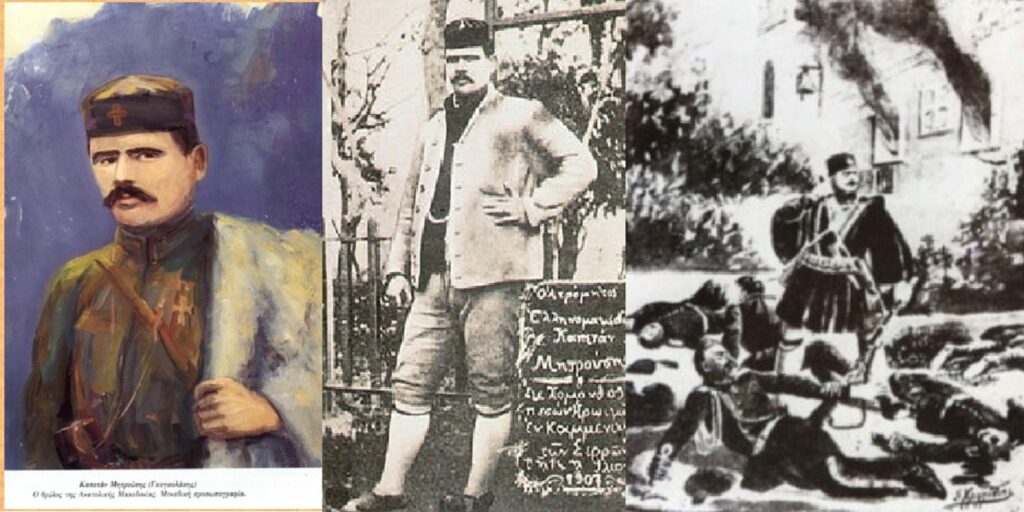
The Macedonian warrior Gogolakis Mitrousis, after having fortified himself in the bell tower of the church of Evangelistria in the district of Kato Kamenikia, falls fighting heroically, after an all-day battle he fought with 4 of his companions, against the Ottoman garrison of the city of Serres and 500 miscreants. Dimitrios Gogolakis was born at the end of the 19th century in Chomondos (Mitrusi) Serres. It was activated early (in 1903) in the armed struggle against the Bulgarian forces. He killed several agents of the Bulgarian committee in the surrounding villages of Khomondo (Mitrusi), among them the agents of the Bulgarian committee in the village of Christos, Christos Sylianov and Mito Milousev.
He collaborated from 1904 with the chieftain George Yaglis from Ierissos. The Bulgarian organization tried to associate him but he refused. Thus, the EMEO ordered his murder, as he was an obstacle to Bulgarian action in the region. On September 1, 1906, the commissar Taska invaded with his group in Chomondo (Mitrusi) with the aim of exterminating him. Captain Mitrousis escaped, but Taska murdered his wife and their only child.
As soon as Captain Mitrousis was informed of the end of his family, he attacked with his body, in Karatzakioi (Monoklesia), where he had information that Taska’s money was hidden. There they killed 30 commissars and fled in fear of the approaching detachment of the Ottoman army. This event caused a general upheaval throughout the Serres region and the Greek Consulate of Serres found itself in a difficult position. So Captain Mitrousis fled to Athens at the beginning of 1907.
There he met, among others, Crown Prince Konstantinos at the Kallithea shooting range, where he was practicing. After a two-month stay in Athens, in the early spring of 1907, he returned to the plain of Serres, forming a small armed force. In July 1907 he pursued the Bulgarian comitatse Dina Arabatzi, but failed to capture or exterminate him.
On July 13 of the same year, he was informed that Taska was hiding in the Kamenikia district of Serres. He settled with four of his companions in the house of the priest of Evangelistria, next to the church. His four companions were Ioannis Urdas and his nephew Michael Ouzounis (Athanasiou), also from Chomondo (Mitrousi) and sergeants Theodoros Tourlentes (from Megalopolis) and Nikolaos Panagiotou (from Agrinio). However, they were noticed by the exarchate Diggos, who informed the Ottoman gendarmerie. In a short time the place was overrun by the entire Ottoman military force of the Serres garrison, as well as 500 miscreants.
Captain Mitrousis pretended to surrender and killed the Chief of Police who tried to enter to pick him up. A fierce battle ensued between the 5 men and the Turkish force. The Turks set fire to the surrounding houses forcing Mitrousi’s group to flee to the church. On their way out, Nikos Panagiotou and Ioannis Urdas were arrested (they were later executed). Mitrousis with Michalis Ouzounis and Theodoros Tourlede were locked in the church bell tower.
After a five-hour battle and many casualties on the Ottoman side, Theodore Tourlentes was killed. Captain Mitroussis and Michalis Uzounis continued the battle until the bullets ran out.
Dimitrios Gogolakis used the last bullet to kill his nephew Michael Ouzounis and then he killed himself with a knife in order to avoid arrest.
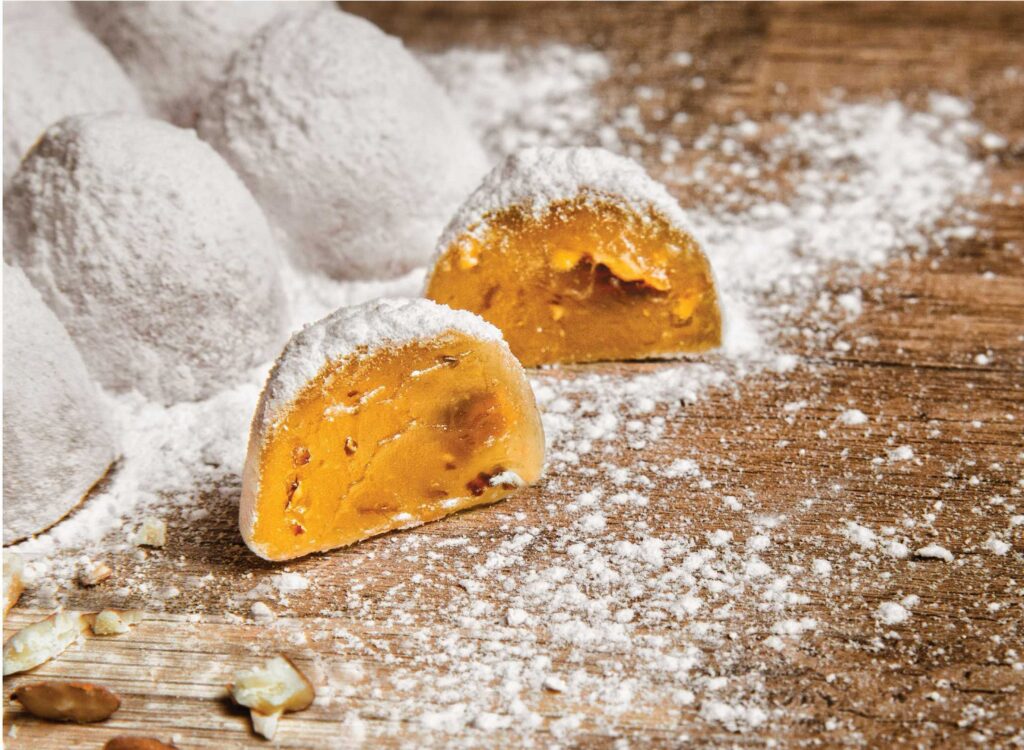
The history of akane in Serres begins during the Turkish occupation, when the Beydes took their summer vacations in Lailia of Serres. It was made using the techniques of the time: in large cauldrons they boiled retzels and petimezia with water from the spring of Lailia. That is why the name “Akanes Lailia of Serres” has remained. It is said that the water of Lailia, being cooler and lighter, was the main ingredient and what gave all the deliciousness to the akane. Petimezia and retzels were replaced with sugar cane juice and starch. Today, instead of sugar cane, sugar is used. The above mixture, after it became thick, added fresh butter and finally nuts.
During the preparation process, because it required many hours of mixing, a slave was always there and stirred the mixture with a wooden spoon. When it cooled, this thick mixture was cut into small pieces and served as dessert.
After liberation in 1913 from the Bulgarians, the enslaved Greeks became artisans and made this sweet in the city.
Today no one can say with certainty where the name Akanes came from. Its history is lost in the era of the Turkish occupation and perhaps with it the history of the origin of its name was lost. There is no solid etymology of the word. Nevertheless, there is a version that may be closer to reality. The word “unable” came, as they say, from the word “to stir”, because the mixture needs long hours of stirring, and from the affirmative “yes”, which was always said by the slaves, who were the ones who stirred the mixture.

The Bulgarian authorities, when informed of the defeat of their army in Lakhanas and Kilkis, took all measures in the city of Serres to isolate its inhabitants so that they would not rebel. On June 20, 1913, at noon, the police officer Popov with five soldiers armed with a lance went to the metropolitan building and asked to arrest the metropolitan and his two assistants. Metropolitan Apostolos was sick. He wrote letters to General Ivanov and the commander of the city of Serron Vulkov. He protested vehemently. They then wanted to arrest only his two assistants, but because the metropolitan reacted strongly they posted a guard and imprisoned them all inside the metropolis. They tried to blackmail the metropolitan to instruct the inhabitants of the city and the region of Serres not to show hostility against the retreating Bulgarians.
On June 24, shots were heard from the heights of the city. Many fled to the metropolis. The defense and munitions commissions supplied them with weapons and munitions from the Bulgarian warehouses. The enemy was fleeing like a confused mass of men and animals. But he had received an order from the Bulgarian government, which wrote about the city of Serres: “If Serres seemed to be lost to the Bulgarians, they had to destroy it.” For the execution of this order, the military and civil administration of the Bulgarians, who were in Serres, were installed from June 23rd together with the military guard on the northern heights of the city. They watched every movement and in case it was lost for them the Serres would burn it.
On June 24 and 25, thousands of shots were exchanged. The militia of the city consisted of Greeks and Ottomans. They were led by the Turkish colonel Agiach Bey. He was a prisoner in Athens, but by order of the Greek government he was sent to his family in Serres to mediate so that the Turks and Greeks of Serres would cooperate against the Bulgarians. The militia of Serres was reinforced by a few soldiers of the Greek vanguard and prevented the entry of the unruly Bulgarian party members to loot the city. The enemy destroyed the bridges of Strymonas, and the Greek army did not receive an order from the General Staff before June 27 to advance towards Serres.
The Metropolitan of Serres Apostolos sent two letters on June 25 to the leader of the scouts west of Strymons. She begged him to hurry as fast as possible to save the city. The next day he sent a special commission from Serres with an urgent letter to the commander of the Greek army beyond Strymons and described to him the terrible situation of the city which was in danger of being destroyed. Those able to bear arms were summoned to their parish and enlisted in the city militia. They alone chose the leader of their group, with which they faced the Bulgarian attack from the heights from June 24 to 28.
Some Serrai took refuge in the consulates of Austria-Hungary and Italy and remained there night and day for security reasons. From the surrounding villages, many gathered in the city of Serres and equipped themselves from the abandoned warehouses of the Bulgarians. On June 27, a new commission was sent to Koumariani and begged the commander of the Greek army to hasten the arrival at Serres. But he could not proceed without an order from the Staff.
They were forced to and personally called King Constantine. The king ordered the VII Division to advance from Strymonikos and the army division that was in Koumariani. The Strymonas bridge was damaged and therefore no help came until Thursday evening, June 27. The only troops that arrived at Serres from 24 June were two platoons of infantry from Mazarakis’ battalion and one of engineers to blow up the bridge of the Serres-Thessaloniki railway line outside Serres, as well as another platoon from Achinos. All these were added to the militia of the city, and together prevented the enemy from carrying out his destructive plan.
At dawn on June 28, a new enemy attack began against the city’s militia. The defense held bravely, but the enemy’s artillery, which was pouring into the city, spread panic among the inhabitants.
On June 29th, in the morning, the VII Division of the Greek army arrived, led by colonel Sotilis. Together with the Greek army, the Serraians who had left also returned. The reception of the army took place in the eastern part of the city, at the Church of Agios Georgios. There the metropolitan came out with his entourage, as well as those who remained in the city, to say “welcome” to the victors with all their hearts.
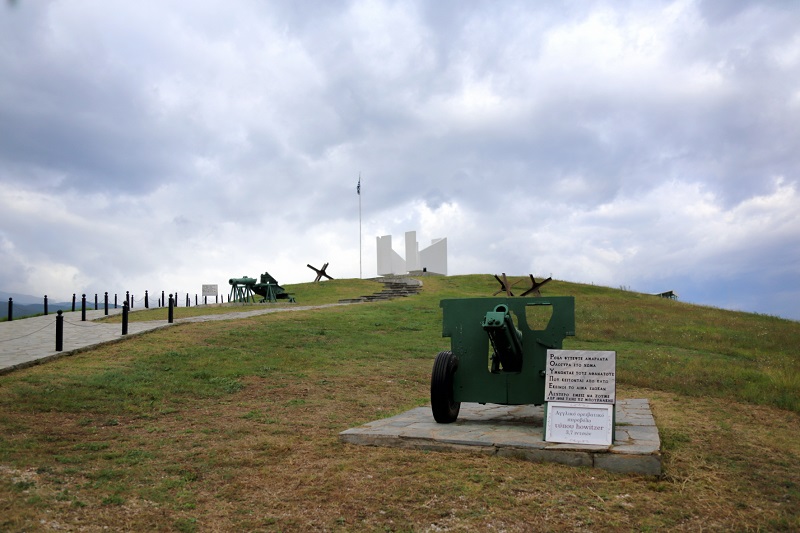
May 1916. The government of Stefanos Skouludis gives the order on May 15/28 that the Greek armed forces hand over the Rupel fort to the German-Bulgarians without a fight. The people of Serre panic and, upon hearing the news that the Bulgarians are coming, leave the city en masse, together with the VI Serre Division, in August 1916.
Sunday, August 28, 1916. Upon entering the city, the Bulgarian troops occupy the Government and destroy all the records of the Prefecture, the Refugee Committee of 1913, the Agoranomy and the Veterinary Service.
The offices of the Court of First Instance of Serres, the office of the Royal Commissioner and the courtroom were completely destroyed. At the same time, the Bulgarians arrest, imprison and finally exile those Greeks who were active in the Balkan Wars, such as: Stefanos Anastasiou, Georgios Masiala, Ioannis Giarika, Dimitrios Olympiou, Georgios Simos et al.
From the day after the installation of the Bulgarian Administration in the Governorate, the Bulgarian Commander demands from the Municipality of Serres to provide hundreds of workers to the occupying forces, for the fortification works on the heights of the Holy Forerunner.
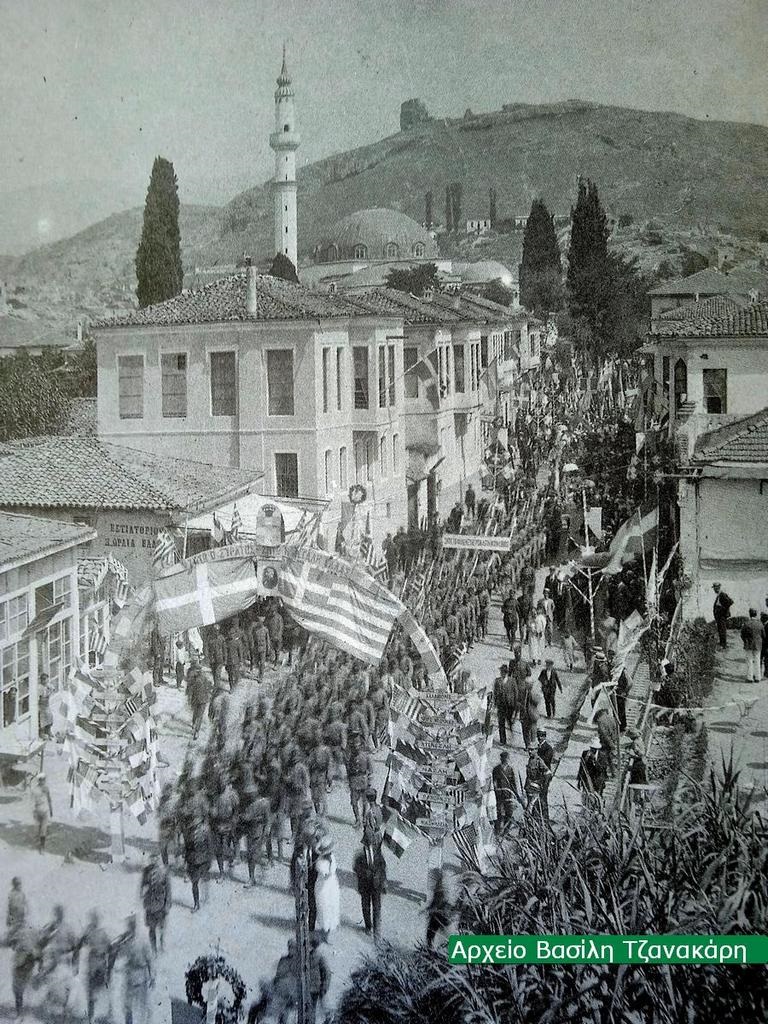
The liberation of the city of Serres, the second to be carried out by the Greek Army in five years, is part of the last offensive effort of the Allied Army of Thessaloniki, which included – in addition to the Greek units of the National Defense Army – units of the French, British , Serbian and finally the Italian Army, which had gathered and organized in Northern Greece.
On 14 September, the Allied command launched the major offensive operation in Axios (Vardar Offensive) as 566 guns opened fire on the 1st and 2nd Bulgarian Divisions in the Dobro Pole ridge area with two French and one Serbian Divisions with decisive results in the Bulgarian lines . As the rift had been created, the allied command hastened to take advantage of it by involving the Greek Archipelago Divisions, III and IV, which, after pouring into the opening, faced pockets of resistance in front of the village of Zborsko and concentrated on Susnica which they occupied and from the evening of the 15th they began to encircle the Bulgarian pockets of resistance.
Moderate results were had by the French and Serbs who with great effort and losses reached their objectives near the ridges of Sokol but failed to grasp it. The Bulgarians lost half of the 12,000 men defending the line and 1/3 of their artillery but refused to give up their positions.
The Greek I Division is ordered to move towards the capture of Serres. The mission is undertaken by the Evzone detachment of I/38 SE (38th Evzone Regiment of the I Infantry Division). On September 21, Serras is reoccupied by the Greek army. On the same day, Generals Daglis and Paraskevopoulos will also enter the city.
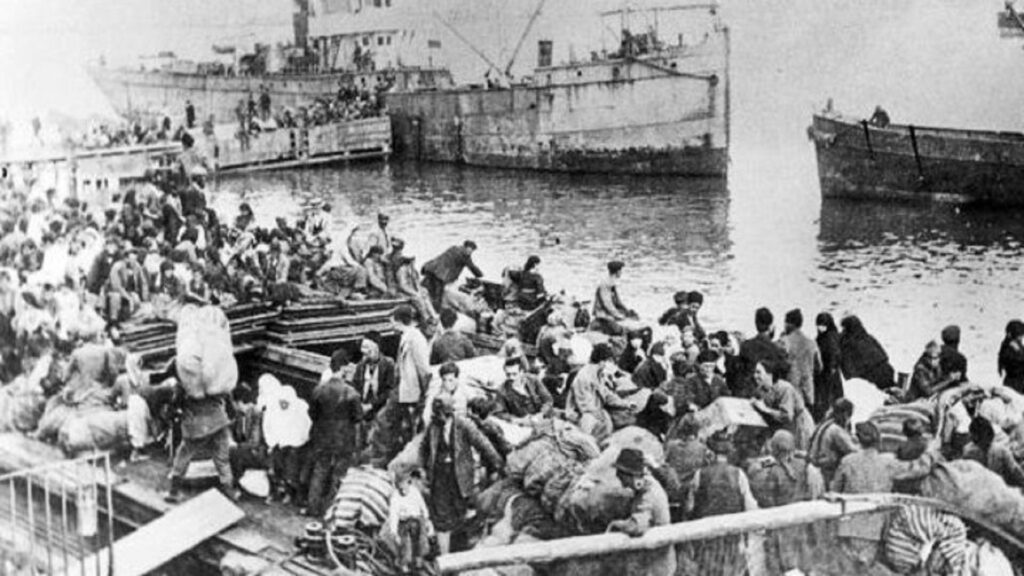
On January 30, the contract with Turkey on the exchange of populations is signed. The city and the district of Serres are full of Greek refugees.
The Lausanne Convention of January 30, 1923 differed significantly from the previous ones, as it was the first in the history of mankind to conclude by convention the mandatory exchange of the population of two different territories, having both a mandatory and mass character. In the case of Greece, the permanent settlement of refugees created rearrangements and competition regarding jobs, pieces of land and business and agricultural activity. This unexpected appearance of culturally diverse refugees in all areas of life created friction in native-refugee relations. The natives of the cities did not see refugees at all positively and considered them rather threatening to their family and economic interests. The natives of the countryside were suspicious of the refugees and did not approve of giving them land, animals, houses, tools. They criticized the continuous facilities and low-interest loans provided by the state. Refugees, for their part, were asked to adapt to new places far from their ancestral homes and at the same time to survive in a linguistically and culturally alien and often hostile society. In the large urban centers where the large percentage of refugees were absorbed, housing problems pre-existed, which were to increase with the arrival of the refugees.
The dwellings were “sunless, cramped, unsanitary and wretched hovels”. The presence of a large motley group of natives and refugees reshaped society and the state’s society while fueling suspicions of an explosion in crime.
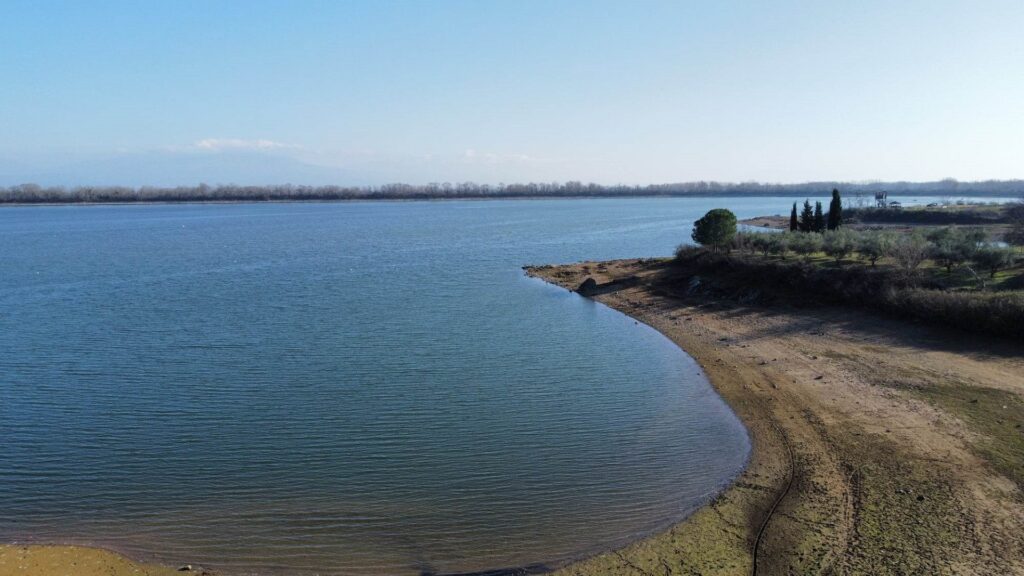
Lake Kerkini is artificial. In the place where it was created, there have been small lakes since ancient times, as well as permanent and temporary marshes. In the southern part of the plain of Serres there was the lake of Achinos, which dried up in the same period and which is identified with the lake Kerkinitis mentioned by Arrian , while today’s Kerkini (Butkovou in Turkish) must be identified with one of the seven (7) unnamed lakes through which the Strymonas passed on its way from its sources to the estuary, and not with the ancient Prasiada, which must probably to be identified with today’s Doirani. These two lakes were probably simple expansions of Strymons, which created or disappeared depending on its supply. After all, Strymonas was the undisputed ruler of the plain of Serres and the euphoria of the plain was due to him and for this reason the inhabitants of the area had deified him and built temples in his honor and depicted him personified on coins.
In 1922, tens of thousands of refugees from Pontus, Eastern Thrace and Asia Minor arrived in N. Serres. They build villages, some swamps are drained, they distribute lands to landless people, but the river Strymonas continues to overflow and destroy the crops. And of course malaria is reaping. Thus it was decided to build a dam in order to control the flow of the river, fight malaria and create a water reservoir, from where large quantities of water will be pumped in the summer season to irrigate the vast plain of Serres.
The lake was designed from 1928 by the Monks – Ulen company and according to the classification of man-made reservoirs by Borland and Miller (1958) it is considered a “foot-flood field”. The completion of the project took place in 1932, when the stabilization of Lake Kerkini was achieved. Initially, the maximum level of the embankments was 32 m, the discharge capacity of the dam 1200 m3 /s and the useful capacity of the reservoir 310×106 m3.
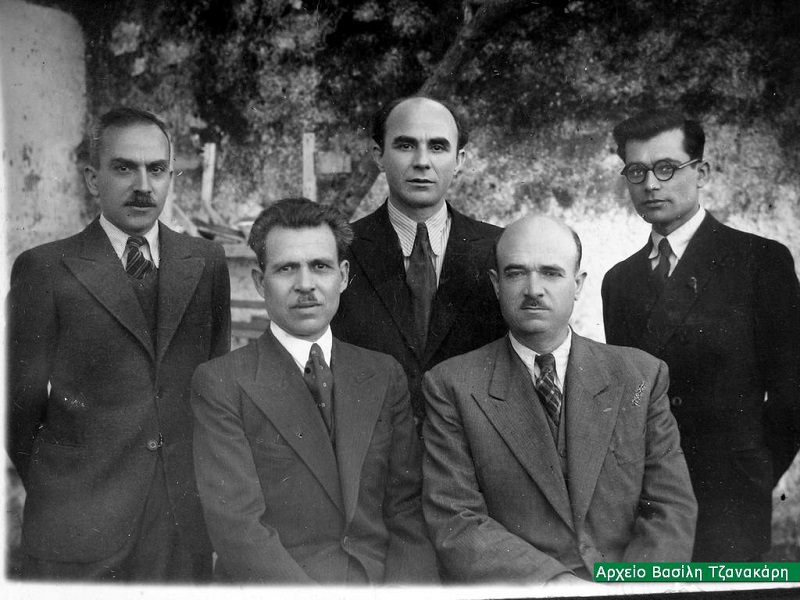
In January, the first left-wing mayor, Dionysios Menichtas, is elected in Serras. Born 1904. Private Servant by profession. He was elected mayor of Serres in February 1934 with the support of the KKE but after four months he was dismissed and displaced. He was elected deputy of Serres with the Pallaikos Front in 1936. He was exiled to Ai Stratis. He participated in the National Council as a member of parliament in 1936.
During the Occupation he was imprisoned in Haidari and escaped in 1944.
After the civil war he was exiled to Ikaria. In the 1951 elections, he was among the persons supported by the KKE for EDA candidates. In 1963 he supported the Center Union.
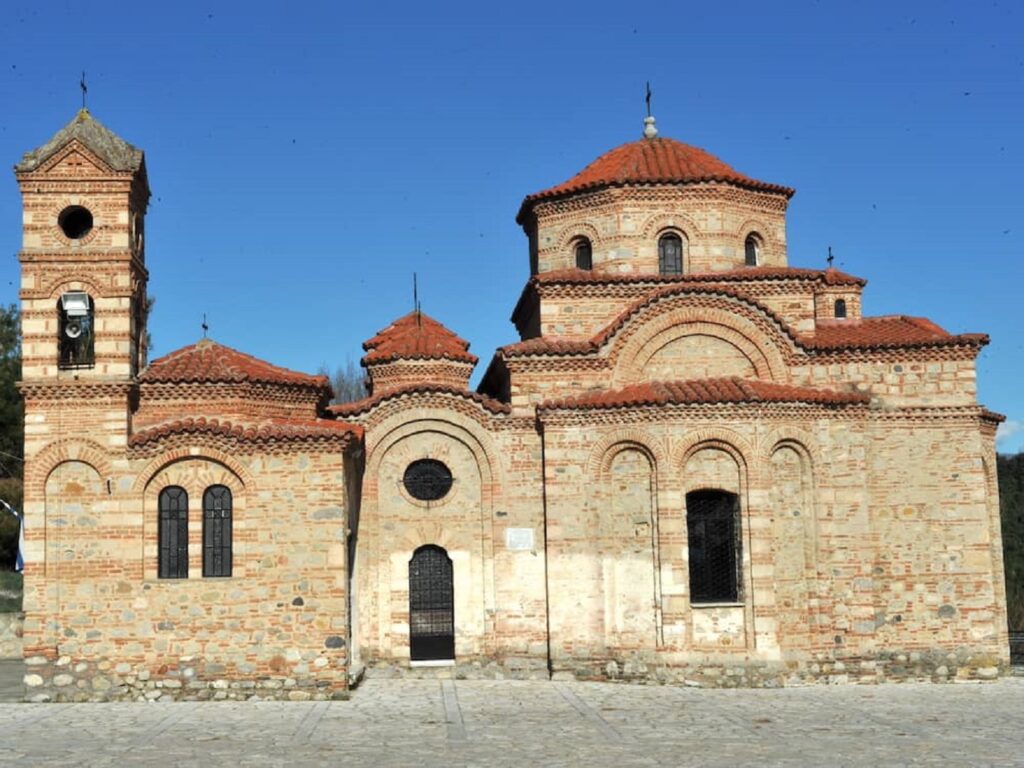
The church of St. Nicholas of Serres is restored. The earliest information about the church is found in an extract from a Tract (1339-1342 A.D.) where it mentions the “tower of St. Nicholas”.
Apparently, this is the tower of the Acropolis, which rose near the anos of St. Nicholas, from where it took its name. The second mention of the temple is in the travelogue of the Turkish traveller Evlias Tselebi (17th century), who mentions that he saw a ruined temple in the then deserted castle. It was certainly the church of St. Nicholas, whose ruin had begun at that time.
From the point of view of architectural type, the church of St Nicholas is classified as one of the usual trinitarian monolithic churches with a dome. It consisted essentially of a central square covered by a dome, which was supported on its eastern side by a free arch, while the other sides were supported by shallow arches that were as thick as the walls. On the west side of the square was attached another narrow oblong space, which formed the narthex. Until 1926, several remains of frescoes were preserved inside the church, such as: a representation of the Divine Communion and the Transmission of the Apostles, Jesus lying naked as a child (Amnos), an angel holding a liturgical replica, a bust of the Virgin Mary tied up, and the icon of St. Modestus, who was blessing with his right hand and holding the Gospel with his left.
In many parts of the church, remains of jewellery in the usual style and themes of the Palaiologan era can be seen. On the east side of the church, under the double window of the arch, there is a crypt entrance, which is reached by a small staircase. This crypt had a cemetery purpose, i.e. it was a burial place for soldiers of the castle’s garrison who were killed or died in it from illness or other causes. The cemetery character of the crypt of St Nicholas is confirmed by the few remains of graves and human bones found in it.
According to the indications of a deed of 1339-1342 AD and the form of the church’s masonry, it is concluded that the Church of St. Nicholas was built before the Serbian occupation and specifically during the first half of the 14th century (Palaeologian era).
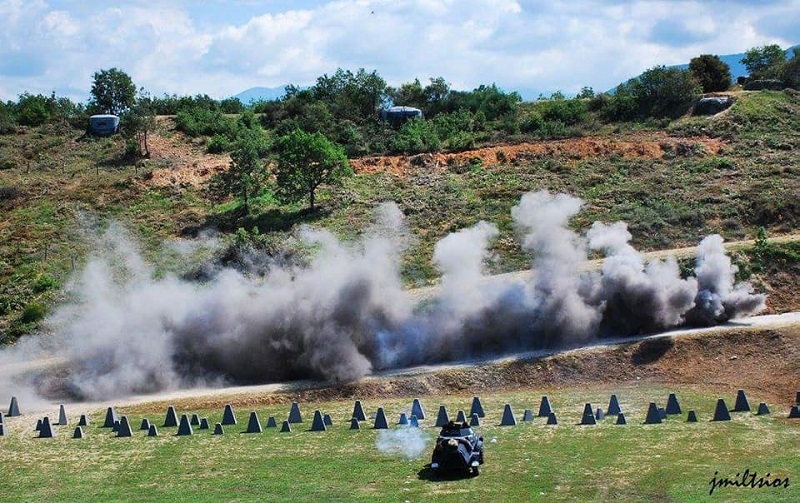
In March 1941, Bulgaria joined the German-Italian-Japanese Axis with the tempting promise that it would be granted all of Eastern Macedonia and Western Thrace. On 2 March 1941 the 12th German Army began to enter Bulgarian territory and on 9 March the advance guards of the advanced Divisions had reached the Greek-Bulgarian border.
The total German forces deployed against Greece were: 3 Armored Divisions, 2 Mountain, 4 Field and 1 Reserve, 2 independently reinforced elite Regiments and 3 Army Corps Headquarters with the corresponding Administrative Units. In terms of Aviation, 650 aircraft were made available (bombers, vertical attack (Stukas) – pursuit, reconnaissance, etc.). Greece lined up 5 Divisions, of which 2 with “retrievals from former border areas” (according to Katheniotis), 1 with overages and 2 with war veterans. Specifically, the fighting strength of the Forts was: 329 Officers and 9,740 Hoplites (total 10,069), however, the deployed strength on 6 April 1941 was 5,630 men, about 62% of the fighting strength. Therefore, if the numerical superiority of the Germans is added to their state-of-the-art equipment, then their superiority becomes absolute. From 05:15 on 6 April, a Sunday, without observing the usual diplomatic customs of the ultimatum and giving a deadline for a response, German troops invaded Greek territory and Southern Yugoslavia simultaneously. (Enterprise “MARITA”).
The main effort of the Germans was directed towards the forts of Kerkini and Agistrou, and in particular against the Rupel fort, while further east, on the Nevrokopi plateau and in Western Thrace, the German attack was of lesser intensity. The ensuing fight did not allow the German forces to break through the fortified position. However, the rapid collapse of Yugoslav resistance, from the very first day, particularly in the area of the Axios river valley and the absence of available forces to cover the left flank of the fortified position, gave the 2nd Armored Division the opportunity and the ability to invades Greek territory through the valleys of the Strumnitsa and Axios rivers. Most of the forts, which remained impregnable, were surrendered on April 10, after the signing of the relevant Protocol (April 9, 1941). The brave defenders of the Forts successfully repulsed almost all frontal German attacks and withdrew with national dignity and honors when their superiors ordered them to. Thus, they emerged as peers of their colleagues on the Greek-Italian front, provoking the admiration of the Germans.
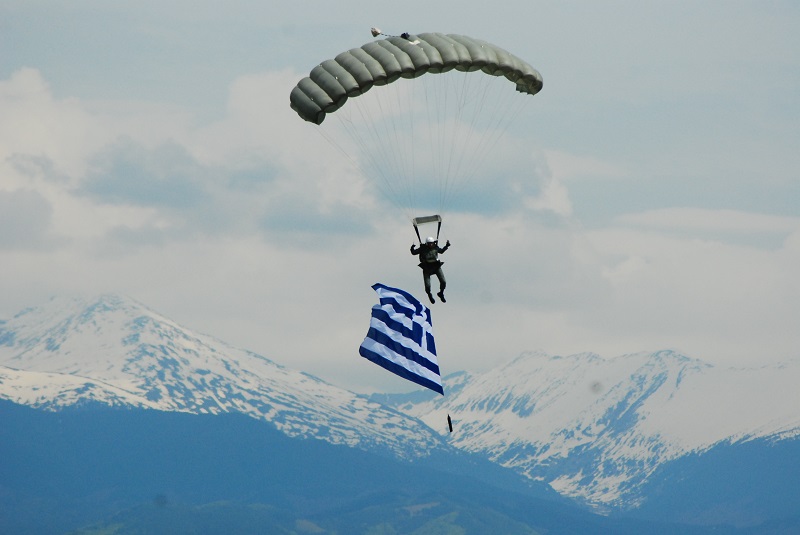
From 1943 to the middle of 1944, the scattered Sierra resistance forces began to take the form of organized organizations. This is how the first factions of ELAS were created in Mount Menoiki and in Lailia. Other organizations that were formed were in Pangaeo led by the Pontian Tsakirides, in Falakro with Pantelis Papadakis, in the forest of Kotza-Ormas, which was a refuge for the Greeks persecuted by the Bulgarians, and in the forest of Elatia (Kara-Dere). In addition, a guerilla group was formed in the Basin Mountains led by Antonis Fosteridis, known by the code name Anton-Tsaous, on whose side many Serrai fought
In 1944, military developments in the European area were negative for the Germans and their allies. This forced the Germans at the end of August to organize their withdrawal from our country, which was completed by October. The withdrawal started from the Peloponnese and the islands, while by October 14 the last German soldier had left Athens. However, the developments were also rapid in the Bulgarian-occupied Macedonia. On September 9 of the same year, power in Bulgaria was assumed by a new government (the Patriotic Front) consisting of persons who had opposed Bulgaria’s participation in the war. Thus, Bulgaria went to the camp of the allies, but without proceeding with the evacuation of Eastern Macedonia and Thrace by its troops. A division of the Bulgarian army remained in Serres, an engineer battalion, an infantry regiment and some other smaller military units scattered towards Strymonas and Sidirokastro.
The consultations that began between representatives of the resistance and the Bulgarians, resulted in an agreement for the surrender of the city, which took place on September 14. Thus, on September 14, the resistance forces of ELAS returned triumphantly to the city of Serres, holding the Greek flag. The entry of the ELAS units, however, was not accompanied by the withdrawal of the Bulgarian troops and authorities from the area. On the contrary, resistance organizations were created in parts that gave the impression that the place is still ruled by the Bulgarians. The delay in the evacuation of the Bulgarian troops was unjustified. Finally, the Bulgarians left the city of Serres, after signing the Varkiza Agreement in February 1945.
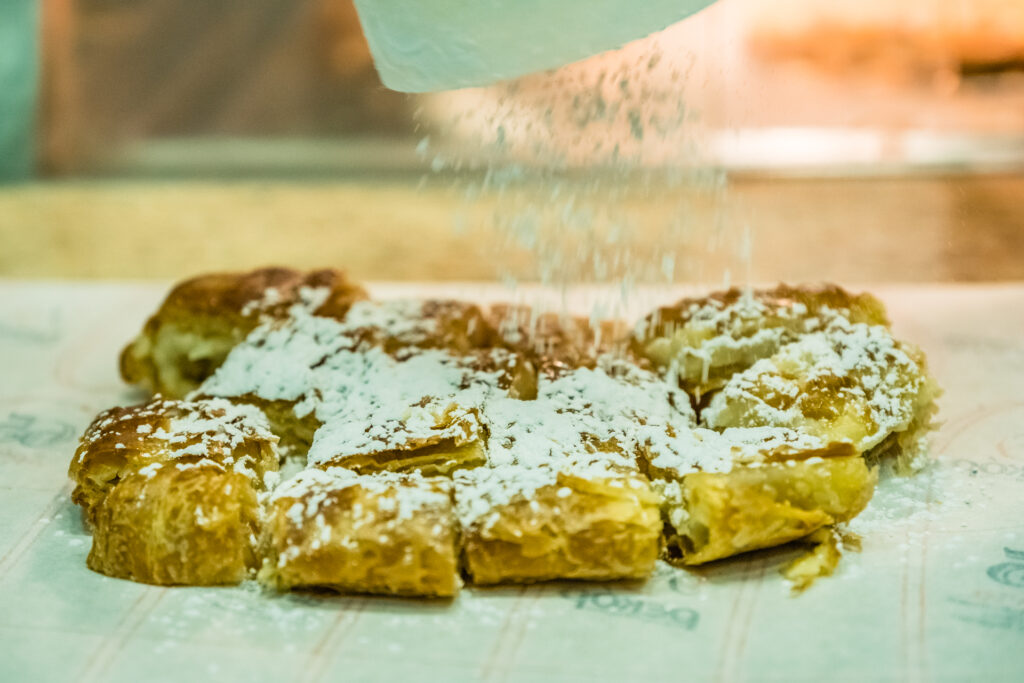
The first bagatsadik opens in the city of Serres, “Anotero”. The original origin of the idea of making bougatsa, according to older reports, comes from the geographical area of Byzantium. More specifically, it seems to come from Constantinople, when it was still Greek, that is, before 1453 AD. , and the conquest of the “City” by the Turks.
It is known that in Byzantium there was a great tradition of pan sweets and pies. Bougatsa is one of the famous traditional pies of Byzantium.
Even after the fall, the bougatsa still excels, according to travel testimony from the 16th and 17th centuries. The traveler Evlias Celebis mentions that in Istanbul two bakeries prepared “kouro bougatsa”, kigmali (with minced meat), peinirli (with cheese) and “sade bougatsa” (sprinkled with powdered sugar).
The inhabitants of the city gave the name “bougatsa” or “bougatsa”, probably meaning “savory or sweet pie filling, wrapped very well and tightly in the dough.”. This is also one of the many main differences that bougatsa has in relation to other pies.
Another key difference is that the sheet is not opened with the help of flour like the classic pies with the patch, but only with the help of oil and soft vegetable butter. Bougatsa was spread in Greece by the refugees who came from Constantinople and the wider region of Eastern Thrace, with the exchange of populations. The first years after 1922, going through after 1940 when there was the war and until 1945 when you started to organize the state better, were very adverse for the bougatsa artisans to practice their art as a profession.
Nevertheless, in Serres there was a craftsman who professionally practiced the art of bougatsa, many years before 1945 as a traveling salesman, Konstantinos Karyofyllis. In fact, in 1950, he opened the first bakery, and named it “Anotero”.
Other well-known citizen bootleggers who brought the art, and opened shops in Serres, were Georgios Flokas from the outskirts of Constantinople who in 1955 partnered with Ioannis Papadopoulos, a well-known Serres businessman in the transport sector, and together they opened the “record bootleg” in Freedom Square city’s.
Also Diamantis Fengariotis from Karakioi of Galata, who later founded his shop of the same name in Serres, Stavros Stavridis who was an expert in the split so-called peinirli. Much later, around 1970 and after, and with the passing of the years, the student-employees of the refugee artisans began to open their own bakery shops. The spread of bugatsa throughout Greece was now only a matter of time.
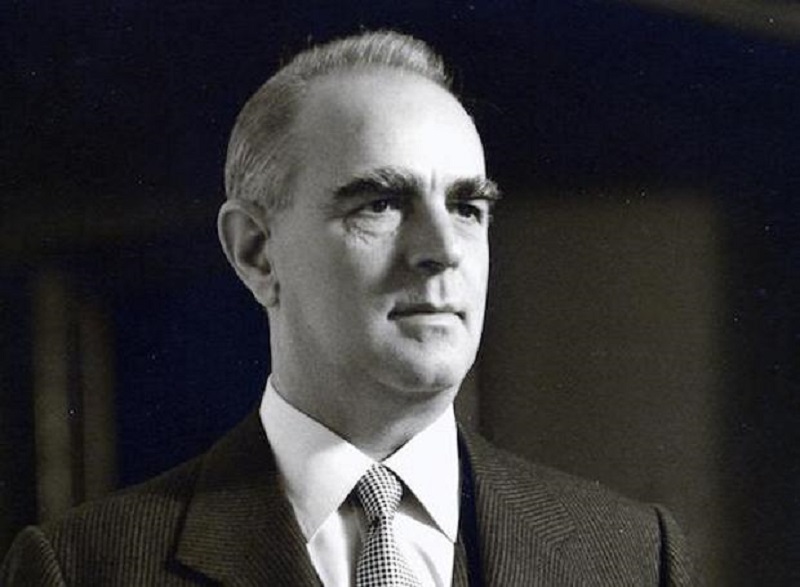
On October 5, Constantinos Karamanlis of Serraios is sworn in as Prime Minister. He was elected for the first time as a deputy of the People’s Party in the district of Serres in 1935. In total, during his political career, he was elected 12 times as a deputy, successively, of the People’s Party, the Hellenic Alarm, the National Radical Union (ENE) and the New Democracy (ND). He founded the last two parties, respectively, in 1956 and 1974.
He was, between 1946 – 1955, Minister of Labour, Transport, Social Welfare, National Defense and finally, Public Works. As Prime Minister, between the years 1955-1963, he laid the foundations for the economic reconstruction of the country. He assumed, in October 1955, as the successor of Alexandros Papagos, the Prime Ministry, which he retained, after three successful electoral contests, until June 1963, when he submitted his resignation due to a disagreement with King Pavlos. Since then, he remained for eleven years abroad formulating, at rare intervals, his views on the need to restore the democratic polity on new foundations. He returned to Greece, while the dictatorship of the Colonels was collapsing, on the night of July 24, 1974, and formed, under his presidency, the Government of National Unity, which actively faced the need for the immediate re-operation of the democratic state and to deal with the national crisis that had been caused after the Turkish invasion of Cyprus.
He prevailed in two consecutive electoral contests in the years 1974 and 1977, ensuring the uninterrupted exercise of power until his resignation from active politics in 1980. In the period 1974-198, it is considered that he restored, on new bases, the democratic regime, definitively resolved the state problem and ensured the country’s integration into the United Europe.
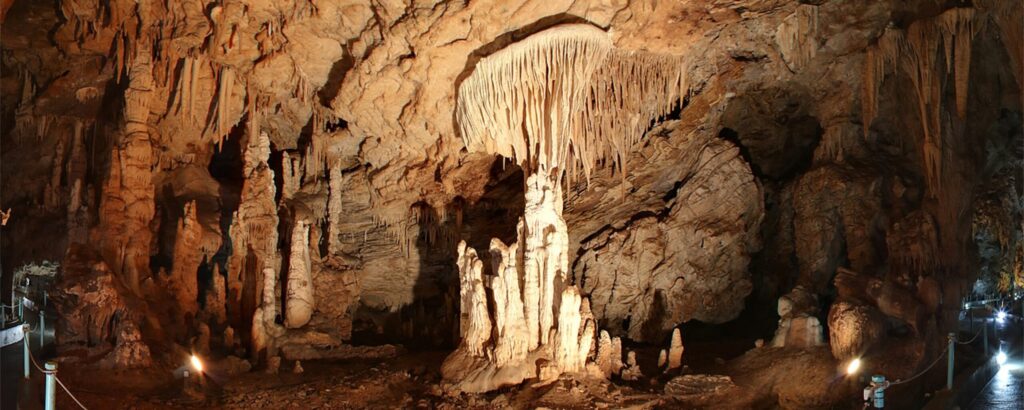
The cave became known on May 19, 1975 to the Speleological Society (ESE) following a relevant document from the Alistratis Community.
The first impressions of Greek and foreign speleologists, geologists and explorers were very encouraging.
The surface of the cave that has been known to date is 25,000 m2 and in many parts of its surface there are sediments of small and large thickness.
These sediments, like the sediments of all the caves in Greece, belong to the Quaternary and of course the fauna enclosed in the sediments belongs to the Quaternary, i.e. it dates from approximately 2,000,000 years to the present day.
In a few places on the surface of the cave, calcified bones were found, which, with a cursory examination, belong to today’s animals. However, the rich sediments of the cave are likely to represent paleontological and prehistoric finds and this will be proven if research is carried out, which can be done without hindering the tourist attraction of the cave.
It has towering ceilings, oversized stalactites, as well as a rare micro-decoration of “eccentrics”, a type of stalactite that grows in different directions.
The primary cause of its genesis is the solubility of the limestones of the “Petrotou” area. The antechamber of the cave is an 8m high room, from which start arcades with great height and rich decoration of stalactites and stalagmites.
From the reception chamber, which has dimensions of 60 m wide, 100 m long and 20-30 m high, the main branches of the cave develop to the right and left.
In the arcades of the cave there are sometimes white eccentrics with various shapes, thin tubular forms of stalactites that reach up to 15m in height, as well as double or rod-shaped or flattened or branching forms called “elictites“.
There are also red stalactites, which have been colored by materials from the surface rocks, as well as huge boulders that form dams or passageways of extraordinary beauty.
The height of the largest gallery reaches about 35 m, while at some point there is a very low small chamber measuring 2 m wide, 3 m long and 50-60 cm high.
The total length of the known main corridors, as well as the secondary ones, amounts to approximately 3 km.
In the cave there are cave-dwelling organisms, among others dilichopods, myriapods and bats, while after studying the climatic conditions, it was found that there is wonderful natural ventilation in all its parts.
The temperature inside the cave during the month of May was found, after measurements, to be almost constant at 20°C, while the humidity was 70 – 75%.
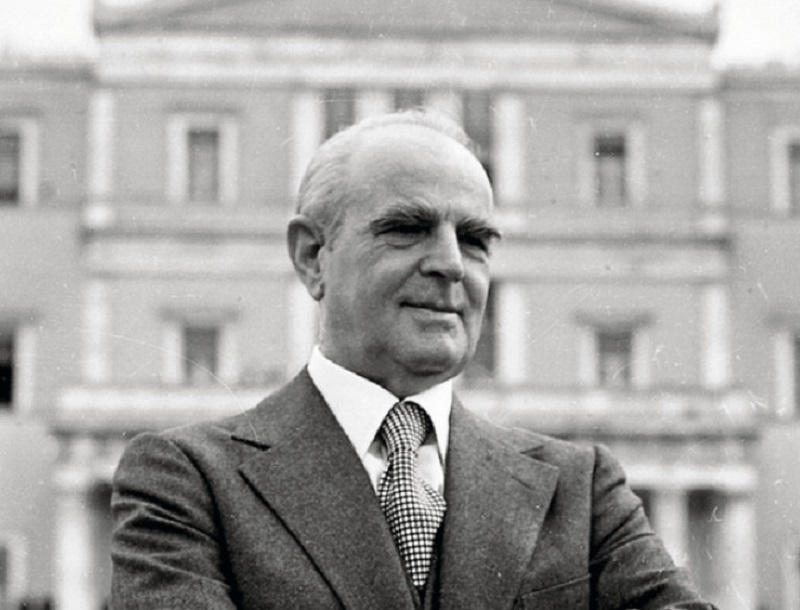
On March 5, Konstantinos Karamanlis is elected President of the Republic. Konstantinos Karamanlis was elected President of the Republic twice, on May 5, 1980 and on May 4, 1990.
As President of the Republic, he guaranteed the smooth functioning of the democratic state, contributed to the strengthening of national harmony and raised the prestige of Greece in the international arena.
He was honored with the European Charlemagne Prize in 1978 and Schumann in 1980, the gold medal of the European Parliament in 1983 and the highest medal of the Universities of Paris in 1983 for his belief in the idea of a United Europe and his fight for the inclusion of Greece in she
. He was also honored with the gold medal of the Onassis Foundation, in 1983, for his contribution to the restoration of democracy, the achievement of Greece’s integration into the European Economic Community, his vision for the revival of the Olympic idea and his efforts to stabilize the peace in the Balkans.
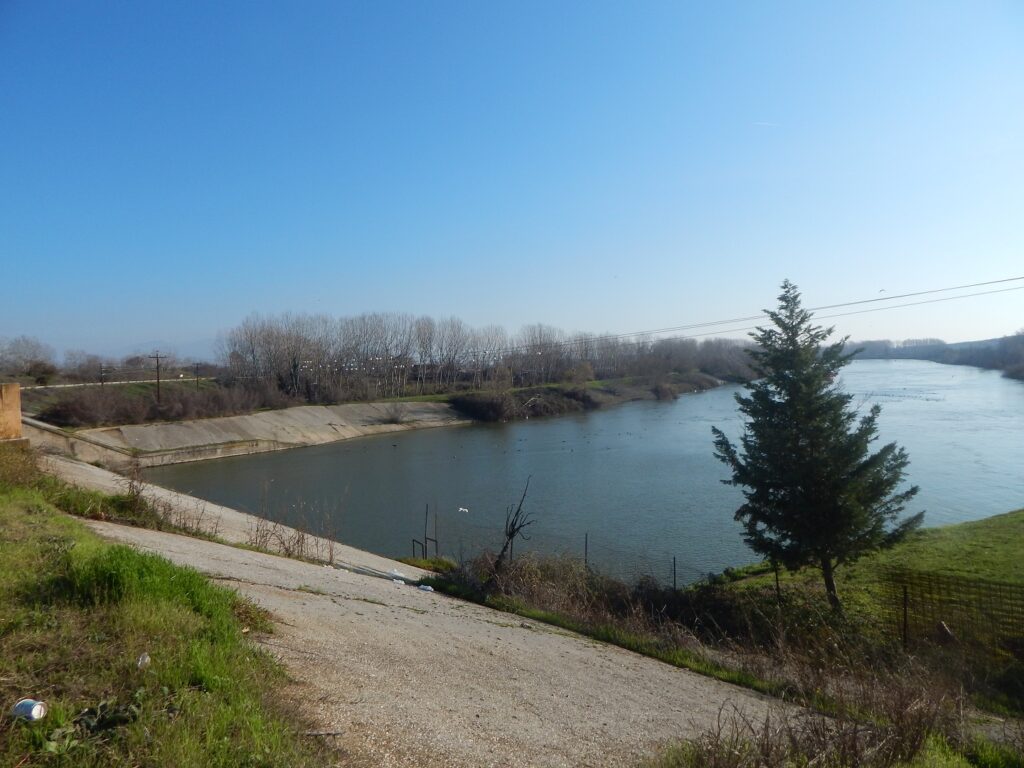
Over the years, the phenomenon of siltation of the lake due to the large amounts of transported materials of the Strymons, raised the issue of raising the embankments and increasing the drainage capacity of the dam. So in 1982 a new dam was built, which for the time being solved the problem. Lake Kerkini does not have a fixed size.
At the beginning of March, the dam closes to collect water. End of May to beginning of June has the most water, an area of about 75,000 acres and a maximum depth of 11-12 meters. In summer the water is used to irrigate the fields. The water level drops noticeably, the area in September is limited to 48,000 acres and the maximum depth to 3-4 meters. To the north grows a vast area of white and yellow water lilies, which can only be admired by boat that goes around the lake. Finally, it can be said that the Kerkini artificial lake turned the tables, as instead of losing flora and fauna by covering areas with water, an important wetland was created with a huge variety of flora and fauna that is even protected by the RAMSAR international treaty.
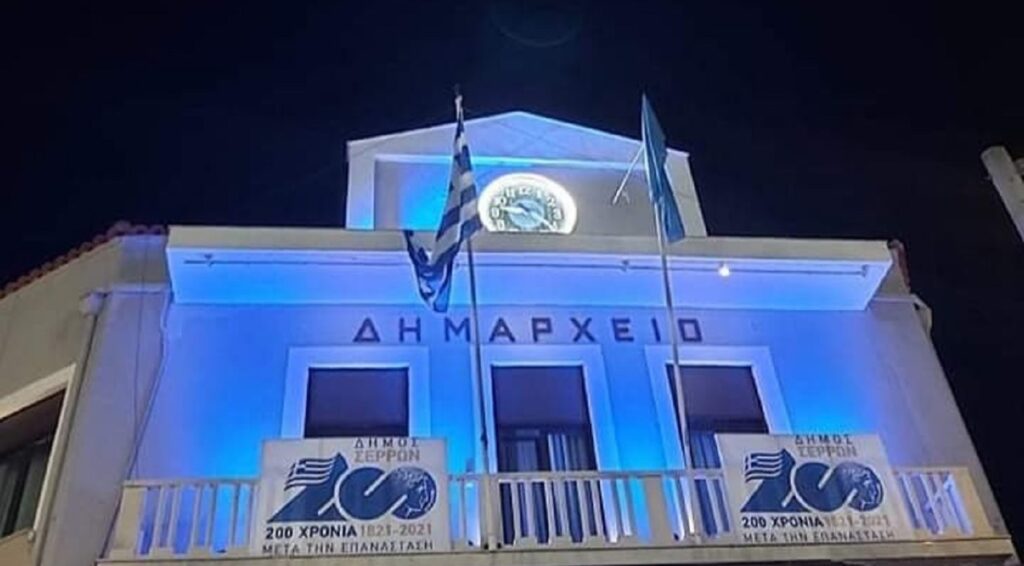
On January 1, the application of Kapodistrias begins. It is the usual name of the law 2539/97 of the Greek state. It was named after Ioannis Kapodistrias, the first governor of Greece after its liberation from the Ottoman Empire. According to the law, the communities were merged into larger municipalities in order to optimize public administration at the local government level.
The administrative division that arose with this law was valid until the end of 2010, when it was replaced by the new administrative division provided for by the “Kallicratis” plan. In 2006, with an amendment voted in the Parliament, Zoniana of Rethymnon, Vrachasi Lasithiou and Tsaritsani of Larissa were officially recognized as separate communities. The “Kapodistria” Law introduced the new term of “municipal apartments” (the former communities).
Due to the abolition of the communities and their transformation into municipal apartments within the municipalities, there was a significant reaction in some areas.
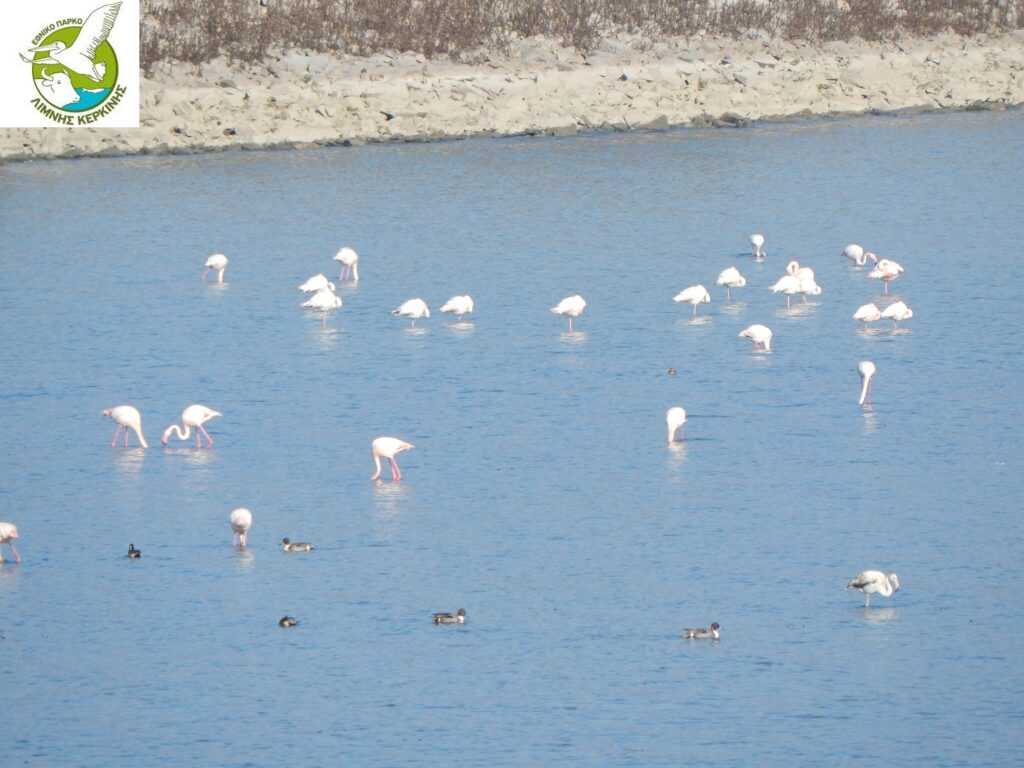
The Kerkini Lake National Park was established in November 2006 (Characterization of the Kerkini wetland and its wider area as a National Park and determination of uses, conditions and building restrictions, (K.Y.A. 42699/19.10.2006, Gazette 98 A. A.P./8.11.2006), in order to protect the area as a national natural heritage, based on:
Systematic monitoring and planning of management projects of the ecological parameters of the area
Continuous guarding and supervision of the protected area
Effective coordination of the relevant services and agencies
Preparation of programs aimed at environmental education, information and awareness of the public and agencies
Ensuring social policy, consent and participation, etc.
The total area of the protected area amounts to approximately 831,000 acres. The protected area includes the areas from Kastanousa in the west to Haropos and Agistro in the east, Heraklia in the southeast and Lithotopos in the south. It includes the mountainous massifs of Kerkini (Beles) in the north and of Mavrovouni and Dysoros (Krousia) in the southwest.
There are four protection zones which are:
Zone A1. It occupies the lower end of the delta of the river Strymonas in Lake Kerkini and encloses three bird colonies.
Zone A2. It includes the parts of the aquatic vegetation east of the settlement of Livadia and southwest of the settlement of Mandraki.
Zone A3. It includes the parts of the aquatic vegetation located upstream of the provincial road Kerkini – Lithotopou,
Zone A4. It includes the south-eastern end of the Krusia mountains.
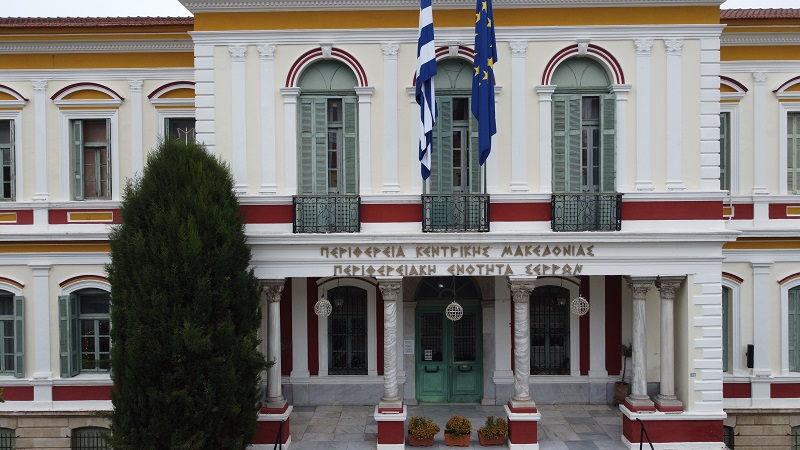
On January 1, the application of Kallikratis begins. It is called the Greek law 3852/2010, which reformed the administrative division of Greece in 2011 and redefined the boundaries of the self-governing units (OTA), the way of electing the bodies and their powers. It is sometimes also referred to as the Kallikrates Plan, from the name it had before being introduced to the Hellenic Parliament for discussion.
The program was passed by the Hellenic Parliament in May 2010. Part of its provisions were immediately activated with its publication in the Government Gazette on June 7, 2010 (Government Gazette 87/t.A’/2010), so that the local elections could be held based on them of the same year. In its full form it entered into force on January 1, 2011. Key aspects of the program are the reduction of the number of municipalities and their legal entities by approximately 2/3, the replacement of the 57 prefectures as secondary OTAs from the 13 regions, the establishment of the decentralized administrations, the changes in the way of financing the OTAs, the increase of the term of the self-governing bodies from 4 to 5 years and the redistribution of the responsibilities of each level. According to Yannis Ragousis, who proposed the program as Minister of the Interior, the criterion was that there should not be a municipality with a population of less than 25,000 inhabitants in the urban complexes of Athens and Thessaloniki or 10,000 for the rest of the country – exceptions were made only for mountainous areas, where the population threshold the limit was set at 2,000 on the islands as well, where the “one municipality per island” logic prevailed (except for the two big ones, Crete and Evia).
For the first time the city of Serres is mentioned historically by Herodotus as a remarkable city with the name “Siris the Paioniki”.
According to the great ancient historian, Paioniki was built by the Paeonians of Phrygia in Asia Minor and their neighbors, the Odomantes. Both peoples had emigrated before the Trojan War was declared. The ancient name Siris stated that the city of Serres was in ancient times the seat of the bright Sun God, Zeus or Apollo.
Today’s designation could be Ilioupoli and its inhabitants called Heliopaeons. Herodotus comes to verify the above, with his reference to the king of the Persians, Xerxes. Siris, as a center of worship of the Sun god, prompted Xerxes to dedicate his golden chariot to the city during his campaign in Greece. It is a golden sacred and untouched chariot, which was drawn by white horses.
It was dedicated to the Sun god (Apollo or Zeus). This specific chariot during the parades preceded the chariot in which King Xerxes was.
The theater of the Peloponnesian war is transferred to the Thracmacedonian shores by the Spartan general Brasidas. The Lacedaemonian general campaigned in Macedonia to firstly create alliances and secondly to besiege and occupy the cities adjacent to Athens. The Paeonians and the Odomantes sided with the Athenians (who had general Cleon as their leader) and went with them to defend Amphipolis. The two rivals encamped near the walls of Amphipolis, while part of Brasidas’ army remained within the walls of the friendly neighboring city. Brasidas with all his army hid behind the walls of Amphipolis.
Cleon, informed of his opponent’s movements, gave the order to retreat in a marching phalanx. Then the gates of Amphipolis were suddenly opened and the Spartan army poured out from inside, attacking the Athenians in the middle of their phalanx and in its rear guard. The Athenians fled in general and had very heavy losses (600 dead) while only 7 of the Spartans were killed, including Brasidas. Cleonas also fell dead in the battle.
The great defeat of the Athenians and the death of Cleonas and Brasidas resulted in the predominance of peaceful factions between the wars. Thus, in the fall of 422 BC the peace negotiations began which ended in the peace of Nikias in 421 BC. The “tomb of Brasidas” was discovered in recent years and the metal larnax with his bones together with a golden wreath is exhibited in the Archaeological Museum of Amphipolis of Serres.
The tomb was discovered during the excavation work of the plot for the construction of the Archaeological Museum of Amphipolis in 1976. It is a box-shaped tomb made of ashlars, carved into the natural half-rock. It was found unclaimed and sealed. It contained a burial – cremation inside a metal ossuary where a golden wreath of olive leaves was found. The position of the tomb inside the walls leads to the opinion that it is the tomb of a particularly important person who was buried with honors within the enclosure of the walls.
Amphipolis was founded by the Athenians in the time of Pericles, by the Athenian general Agnos, at the mouth of the Strymons, on the site of a city formerly called “Ninea Odoi”, or very close to it. According to Thucydides, the city was named so because the river Strymonas flowed around it, surrounding it.
The position offered her two aspects. One towards the interior, Strymons with the lake of Achinos and ancient Tragilos and the other towards the sea and Iona. At its highest point was the “Acropolis”, which was protected by a wall. The Athenians were interested in gold, the dense forests of Pangaeus and silver. Their success, however, was again short-lived, since at the end of the first decade of the Peloponnesian War (422 BC), Amphipolis seceded from the metropolis of Athens and remained an autonomous city until its incorporation into the Kingdom of Macedonia by Philip II ( 357 BC).
In the northern part of the wall, the largest and most fortified gate of the city (gate C) has been excavated, which led to the bridge over the river Strymons, which was made of wooden piles. A special place in the city was occupied by sanctuaries dedicated to local deities and demons, such as the muse Cleo, the equestrian hero Rhesus, the Nymph, the river Strymonas and above all Artemis Tauropolos. However, the findings also provide important information about the worship of the Olympian Gods, such as the Pythian Apollo, Artemis, Aphrodite, as well as Herakles, the Dioscuri, and Asclepius.
The focus of the religious life of the city was the worship of Artemis Tauropoulos, while in the Hellenistic and Roman years the worship of the Egyptian gods and the eastern deities Cybele and Attios became particularly popular. The numerous finds from the excavations are exhibited in the Archaeological Museum of Amphipolis and the Archaeological Kavala Museum.
In 357 BC the Macedonian king Philip II captured Amphipolis. The region of Thrace has always been a theater of conflicts between opposing forces. In the period before Philip’s campaigns, however, the situation was quite stable.
Control over most of the region was enjoyed by the kingdom of Odrysas, which had spread during the reign of King Kotyos. His territory reached as far as the region of Hersonissos, in which he even controlled the cities of Kardia and Sestos.
Kotys was murdered in 360 BC. by two citizens of Aenos, Python and Heraklides, who were even honored by the Athenians for this act. After the murder of Kotyos, the kingdom of Odrysas lost its cohesion, as apart from Kersevlept, Koty’s successor, two other rulers emerged, Amadokos and Verisadis, who acquired independent territories in the area of the divided kingdom. This situation was beneficial for the other interested party, especially in the area of the peninsula, Athens. The Athenians had traditional ties to the region of Thrace, which they had systematically colonized since the time of Pericles, and were in open conflict with both Coty and Kersevleptis, who with the help of mercenary leaders repelled the Athenian attempts at conquest. of Hersonissos. The Athenians therefore used the visions of Verisades and Amadokus to thwart the expansionist visions of Kersevleptos.
The conflicts seemingly came to an end with the signing of the Treaty of Charitos in 357 BC. However, Kersevleptis systematically violated the treaty by demanding duties from the Athenian ports and customs, while from 357 BC. the famous allied war broke out which led to the collapse of the Second Athenian Alliance and the weakening of Athens. Then Philip, king of the Macedonians, took the opportunity and took the first step towards the conquest of Thrace by capturing Krinides, which took place in the year 357/6 BC.
The invitation of the Krinides, a colony of Thassos, which was located in the northern part of the gold-rich Pangaean mountain, gave Philip the opportunity he had hoped for to spread further east. The Krinides were facing the aggression of Thracian races, possibly the children of Berisades (he himself had died the previous year), and they fled to Philip for protection. Philip, after successful wars, occupied the area, rebuilt the city, installed new settlers and renamed the Krinides Philippi, giving the city his name. The rich deposits of Pangaeus – which according to scholars exceeded 1000 talents per year – redefined Philip’s policy and broadened his goals.
This occupation, however, activated the reflexes of the neighboring rulers, who immediately began negotiations for the creation of an alliance, with the objective of subduing the villages occupied by Philip and expelling him from the Krinides.
In this tripartite alliance, which with the addition of Athens became a quadripartite, took part the ruler of the Odrysas Ketriporis (the successor of Verisades) and his brothers, the ruler of the Paeonians Lyppeios and the leader of the Illyrians Grabus.
But Philip did not passively wait for the attack of the alliance, but took the initiative of the movements and with aggressive action managed to defeat the opposing coalition. Thus the area of Odrysas held by Ketriporis and his brothers became a vassal kingdom of Philip and Nestos became the boundary of the new extended Macedonian territory.
Ioannis Tsimiskis did not take strict measures of military occupation in a part of western Bulgaria, and the family of voivode Turnovo Nikolaos Sisman with its four children, the so-called Komitopoulos, found the opportunity to prepare a rebellion. Sisman with his four sons, David, Moses, Aaron and Samuel, claimed the Bulgarian throne. The children of the deceased in January 969 AD. King Peter, Boris II and Romanos, were political prisoners in Constantinople.
The Byzantines left in 976 AD. the legitimate heirs, Vori and Romanos, to escape to organize a resistance movement against the claimants to the throne. Unfortunately, on the way back, Boris II was killed by a Bulgarian guard who mistook him. Romanus lost the throne and joined the Sisman family. The voivode of Turnovo Sisman together with his four sons took advantage of the attitude of general Vardas Skliros, rebelled in Bulgaria and upset the entire Byzantine Empire.
Of the four sons of Shishman, David was killed at the beginning of his action. In the spring of 976 AD Moses marched with a large army into Macedonia and closely besieged the city of Serres. The city resisted because it was very well fortified. Its defender was Duke Melissinos.
The siege lasted a few months. We do not know in detail what took place around the walls. The only thing that Kedrinos informs us is that while Moses was roaming around the walls of the besieged city of Serres “he was thrown from the wall by a stone”, meaning he was hit and killed with a stone thrown by the defenders from the walls. Others say that while riding his horse around the city walls he fell from the horse and was killed. After his death his army lifted the siege and fled. The city of Serres was temporarily freed from the enemy.
The war between Samuel and the emperor Vasillio II was adamant, long, stubborn and destructive, because it was a war of life and death. Taking advantage of the positions of two Byzantine generals, Scleros and Vardas Phokas, Samuel began the war.
The Bulgarians turned their liberating struggle into a conquering one, aiming to occupy the entire Balkan peninsula. Starting first at Prespa and then at Achrid, Samuel occupied western Macedonia, Epirus and then the whole area between the Danube and Aemos. He made Ahrida his capital and re-established the Bulgarian Patriarchate, which had previously been abolished by Ioannis Tsimiskis. He extended his state from the Black Sea to the Adriatic and from the Aimos to Thessaly.
In 980 AD Samuel turned south. During his march, he attacked the city of Serres. He was not able to conquer it, because it was very well fortified and excellently organized. The fortification of the city thwarted the plans of the conqueror. In his wake, the region of the prefecture of Serres was once again plundered. He assaulted Thessalonica unsuccessfully and besieged Larissa very closely. He also threatened the Peloponnese, advancing with plunder and destruction as far as Corinth. When Samuel learned that Emperor Basil II had invaded Bulgaria from the Rhodope straits heading with his army towards Sofia, he took the way back. The emperor hastily returned to Constantinople because there was a revolution against him.
During his retreat the Bulgarians ambushed him. After difficulty he was rescued in Philippopolis in August 986 AD. Fortunately he was released in 990 AD. from the internal positions and resumed the campaign against the Bulgarians from Thrace and Macedonia. For the first time he came to Serres and fortified the city to withstand any enemy attack. It strengthened its walls with strong towers. He fortified the city of Serres to have it as a base in the campaigns against Samuel.
Samuel started the stealth war again in 1014 AD. setting up ambushes in narrow paths. He avoided fighting with Basil II, even though the latter annoyed him by invading Bulgaria every year, setting out from Serres. Kedrinos writes: “and the king did not pass each one of them in Bulgaria and in some measure both” (that is: the emperor Basil II did not fail to invade Bulgaria every year, destroying and cutting everything he met on the way of plundering the land of Samuel). They both stubbornly persisted in this long and destructive war. It was a life and death war between the two states.
Samuel made it his goal to remove the lands of Europe from Byzantium. He would certainly have done it, if Basil II had not been emperor at that time. Samuel decided to strike Basil II for the last time at the Key, in 1014 AD. He built a wall in the strait of Strymonas, at the Key of Sidirokastro. It blocked the passage of Basil to the north with an army of 15,000 plus well fortified behind the wall and the surrounding heights.
To create a distraction for the Byzantine army, he sent men with general David Nestoritsis from the mountains of Doirani to Thessaloniki. The general of Thessalonica Theophylaktos Botaniatis defeated the Bulgarians and put them to flight. He advanced and joined the rest of the Byzantine army. Together they tried to raid the straits of Strymons. The Bulgarians were well fortified behind the wall, and from the surrounding heights decimated the Byzantine army.
The months passed and the emperor grew hungry. He despaired day by day. According to Kedrinos, the general Nikiforos Xifias was patrolling Mount Valathista south of Kleidi with an army squadron and from a difficult path in the area of Aggistro found himself on July 29, 1014 in the south of the defending Bulgarians. The Bulgarians were surprised by the unexpected encirclement and panicked when they found themselves between the two divisions of the Byzantine army, being pushed at the same time by the emperor Basileus and the general Xiphia. They fled. Several were massacred and many were captured. Samuel was saved from captivity with great difficulty. He managed, with the help of his son, to get on a horse and take refuge in the fortress of Prilapos, in Perlep
Even before the Franks captured the city, they divided the Byzantine Empire between them. They determined in advance where they would give the offices. Candidates for the Byzantine throne were Boniface the Momferatikos and Baldwin, Count of Flanders, but with the intervention of the Doge of Venice Dandolo, Baldwin was elected the first Frankish emperor of Constantinople. Boniface was given Asia Minor as a share, but he did not accept it. He wanted to become king in the second city of the Byzantine state, Thessaloniki, with all of Macedonia, which he considered to belong to his family because Manuel I Komnenos had given it as a dowry to his daughter Maria who married Boniface’s brother, Rainier .
Baldwin did not accept the exchange of the area of Thessaloniki and therefore, pursuing the fugitive Byzantine emperor Alexios III Angelos, he passed through Serres and subdued Thessaloniki. Boniface regarded this as an invasion of his fiefdom, and took up arms with the intention of striking a blow with Baldwin. The crusaders intervened and referred the matter to the judgment of the Council of Comets and Barons, who vindicated him and Boniface was officially crowned king of the state of Thessalonica, which included today’s Central and Eastern Macedonia and part of Western Thrace up to Mossinopolis.
Boniface, leaving Margarita as commissioner of authority in Thessalonica and having with him his ancestor Manuel Angelos, passing through Serres in 1208 AD with many knights and rulers, attempted to occupy the area that was given to his state. He occupied the cities without resistance because he behaved very diplomatically with great sympathy and secularism towards the Greeks. He was liked by the Greeks because of his affinity with the Byzantine imperial family. They considered him their own compared to the other Latins. Boniface installed a strong Latin garrison at Serres of skilled warriors. He left his marshal, the noble William de Onois, and the perfect knight Hugo de Coligny as leaders, and a great multitude of his best followers. The example of Serres was imitated by other cities in the regions of Thessaloniki and eastern Greece. They received the noble marquis without a fight.
Frankish writers refer to Serres with a distorted name, as Sarra, Serra or Serta.
After the destruction of Theodore Duke Angelos at Klokotnitsa in Bulgaria (see Haskovo), the tsar of the Bulgarians Asan, taking advantage of his victory, advanced into Thrace and Macedonia and occupied within a few months all the cities that Theodore had liberated from the Franks, namely Adrianople, Didymoteicho, Xanthi, Ahrida, Prilapos and Serres. Thus the city of Serres again fell into the hands of the Bulgarians, but without causing any damage.
Asan was a moderate ruler and struggled in every way to curry favor with the Greeks. The kingdom of Thessalonica did not mind, because the younger brother of Theodore, Manuel, the son-in-law of Asan’s daughter, was declared emperor in it.
Theodore ruled from 1230 to 1237 AD. as a vassal sometimes of Asan and sometimes of John Vatatzis, emperor of Nicaea.
The great domestic Andronikos Palaiologos advised the emperor in 1230 AD to try to conquer the city of Serres. He argued that if they captured it they would have a big cedar: they would humiliate the Bulgarians and force them to send ambassadors to reconcile and ask for peace, as they were ruled by the minor Michael. The king adopted his advice and immediately left Philippi for Serres. He arrived there and camped on a hill outside the city, possibly Maroulis Hill above the Monastery of Saint George. He did not have an army worthy of battle with him and that is why he was trying to conquer the city with strategies and diplomacy.
The city of Serres was once very large, but Voulgaros Ioannitsis in 1206 AD. he had besieged it and reduced it to ruins, like many other Macedonian cities. Varosi was then like a village. Only the Acropolis was walled and prepared to face war. Its guard was the Bulgarian Dragotas. The lower city was without walls, because Ioannitsis tore them down. Only the unlimed stones were piled two meters high, as roughly as a pen. Emperor Vatatzis immediately summoned the mercenary soldiers who accompanied him. They were called tsulukones, that is, a mob of lower social status. In a way he provoked them to take over the city. When they saw the lower city without walls they considered it an easy prey and proposed to march against it themselves. Food was scarce among them, and it was absolutely necessary to attack immediately to procure the necessities of life. That is why they immediately grabbed their bows, swords and with improvised wooden shields rushed towards the city of Serres shouting war cries.
Serres did not have many inhabitants then, because most of them had been captured and slaughtered by Ioannitsis. The Bulgarian soldiers who lived in it were easily defeated. Some of them reached and climbed the Acropolis and others went outside the city and fell at the feet of the emperor Vatatzes. The Bulgarian guard of the Acropolis Dragotas, when he saw that the lower city was captured and only the Acropolis remained, because he was informed of the death of the twelve-year-old king of Bulgaria Kaliman and had no experience in guarding fortresses, therefore without delay he sent ambassadors to surrender the Acropolis to the Byzantine emperor. The Greeks of Serres joyfully hailed King Vatatzis. The king honored Dragotas who handed over the city to him. He gave him enough money and clothed him in gold-woven cloth
In the fall of 1342 AD Cantacouzenus set out with his army from Serbia for the Didymoteichos, which was commanded by the wife and son-in-law of Asan. He was also accompanied by the king of Serbia, Dušan, to Serres, which was still resisting. Kantakousinos and Dusan wanted to force the inhabitants to surrender the city. Dusan of Serbia as an ally of Cantacuzenus, before damaging the region, sent ambassadors to the Serrai and advised them to surrender the city to Cantacuzenus. If they acceded he would himself become their friend and ally, while he would be the enemy of those cities which would prefer to fight him. These oaths of alliance were given to each other by Dusan and Kantakousinos. If the people of Serres were convinced and willingly joined Kantakouzenos by surrendering the city, they would leave Serres as soon as possible for Didymoteicho. They promised them that they would not be harmed. But if they seemed ignorant, he threatened them that he would cut down all the trees in the area and cause them great destruction.
The Serrai expelled the king’s embassy and said that because of their enmity towards Cantacouzenus they preferred to suffer everything rather than surrender the city. In this refusal, they were motivated by the relative of the Palaiologos, the commander of the city, Konstantinos Palaiologos. They declared an open war against Kantakousinos without any reason. Cantacouzenos, sensing the great destruction that would befall the beautiful city of Serres because of their insensitivity, sent his own representative to beg them to pity themselves. Let them not suffer incurable afflictions, because of their hatred of him, but take care of themselves. He begged them with his sent ambassador to be persuaded. He preferred that he and his guard not be received in the city, but that he be commemorated in the sacred ceremonies third in line, after the queen mother Anna Palaiologina and her son John V, as emperor. They would be freed from the siege and its miseries. The Serbs, according to the oaths of the alliance, would do them no harm and injustice. He himself would leave to capture Constantinople. If they remained with the Paleologues, they had to hold the siege defense without food. He advised them to think logically, with prudence and understanding to avoid the miseries of war. They began to curse the envoy and hurl many accusations against Cantakuzenus, saying that he should think about himself and his people and not themselves. Kandakouzinos and his followers were in great perplexity. They decided together not to linger any longer in Serres, but to leave for Didymoteicho as soon as possible in order to achieve something better. Kantakouzenos agreed with Stefanos Dusan and left taking the army he granted him. Dušan remained with the rest of the Serbian army in Serres and besieged it. He cut down the trees of the plain destroying everything in the area of Serres.
Stefanos Dusan did not take long to show his insidious purposes. In fact he did not want to help one of the warring factions, Cantacouzenus or Palaiologos, but only to take advantage of the Byzantine civil war to seize territory from them. Kantakuzinos with 20,000 cavalry was outside Kavala and with the Seljuk Umur was asking Stefanos Dusan to abandon the siege of Serres. They unexpectedly learned that on June 11, 1345 AD. the grand duke Alexios Apokaykos, the cause of all calamities and evils, was murdered by prisoners in Constantinople. At Umur’s urging, they left Serres and went as quickly as possible to Constantinople to take advantage of the new situation. Unmolested, Dusan continued the long siege of Serres. Kantakouzenos did not want the Macedonian cities to be handed over to the Serbs, but because of his preoccupation with many other problems he could not defend them.
All of Macedonia up to Kavala, except Thessaloniki, was enslaved to the king of Serbia. During the siege of Serres, Dusan destroyed the entire region. He cut down all the trees and made everything desolate. However, when he captured the city, he did not destroy it, like Ioannitsis. He forbade the massacres and looting of the invading Serbian soldiers. He tried to curry favor with the residents. It is possible that this was one of the terms of the surrender of the city, since the surrender was due to hunger and great need. He entered the city on Saturday at nine o’clock in the morning. The next day, Sunday, he went to church in the old metropolis of Aghii Theodori and began to be friendly. He recognized the property of the monasteries by issuing golden decrees to secure it
Ioannis Ouglesis and his brother Vukasin were killed on September 26, 1371 in Evros by the Turks, in the battle of Tsirmen. The state of Dusan and his successors became tributary to the Turks. However, Serres was liberated by the despot of Thessaloniki, Manuel Palaiologos, and came under the rule of Byzantium. The few Serbs who remained in Serres accepted the cooperation of Manuel II. The city of Serres returned to the Byzantines without siege and bloodshed. Manuel did not bring about changes in Serres in terms of administration, because everyone preferred the Greek restoration to the Turkish occupation. Recapturing Serres from the Serbs, he made sure to fortify the dangerous parts of the Acropolis on the northern side, from where it was vulnerable. Repair or build three towers. Serres was then the biggest bastion towards the east against the Turks. The same fortification was done by Manuel II in other fortresses, trying to positively organize the resistance against the Turks. Manuel II’s authority at that time started from Nestos and reached Vermio, including Veria.
The situation of the Byzantine state was desperate. From the long civil wars the state was completely weakened. The Turks settled permanently on the peninsula of Gallipoli, fortified it and watched over the peninsula of Aemos, the Balkans and the whole of Europe. The Balkan peoples were unable to unite to face the common enemy. They were exhausted by long wars and internal, social and political upheavals.
The Turks, however, were furious that a Byzantine prince was found to oppose them. The Chets dispersed in eastern and western Macedonia and continued their plundering and destruction. They did not occupy the castles projecting resistance, such as e.g. of Serres. They bypassed them and proceeded only to plunder Macedonia.
The Ottoman Empire occupied the city of Serres and included it in its buildings until 1913. The period of Turkish rule begins in the prefecture of Serres with the occupation of the city by the Turks. The events of the capture of the city are recounted by the Turkish historian Seateddin Muhammed, who wrote the “Crown of Stories”.
Sultan Murat I ordered the commanders of Andrianoupolis and Prussia, Lalasiachin and Evreno Bey, to occupy Thrace and Macedonia with the help of Hairedin. The first to besiege Serres was the Turkish general Delio Bebas Beys but he was unable to capture it with his own troops. Then general Lalasiahin came to add his own army, but again it was impossible. To them was finally added the general Evrenos Beys with his own troops. Serres was very suffocatingly besieged by the Turkish troops for eight months.
The impregnable fortress of eastern Macedonia was pressed by a lack of food without any hope of salvation. Until on September 19, 1383, Serres surrendered to the Turks after they first imposed some conditions on them which they accepted. After the conquest, Sultan Murat I himself came to the city, stayed for several days and founded the first Turkish Eski Mosque which was preserved until the first decades of the 20th century and was located next to Bezesteni, the current archaeological museum that was built and this almost at the same time. Also, the Turks then demolished the wall and the strong castle of Serres in order not to become a center of resistance in case the enslaved Greeks rebelled
After the fall of Constantinople, the position of enslaved Christians continued to deteriorate. The Turks violated the privileges they gave and tried in every way to forcibly convert the Christians to Islam. The most terrible of all was the pedomazoma, which at first took place every five years and they took 1/6 of the young children from 7 years old and older. Then they started every four years, every three years and finally they collected children from the Christians every year. Wailing and wailing were made every year when they came to Serres to snatch the innocent Christian children from their mother’s arms. Because the Turkish army was impertinent, undisciplined and insubordinate, diverted to much debauchery and disorder, Kara Khalil Tsenterli thought of taking advantage of the advantages of the Greeks. He formed a new army of Christian children who converted to Islam after child molestation. They took by force from Christian families the best boys at the age of 7 years, before the feeling of religion, family, country was established in them, and after cutting them off from all previous ties to country, religion and family, they turned them into murderers of their parents and unsparing enemies of Christianity and Greece. This new army of the Turks (the Janissaries) was formed by fifteen-year-old Christian children converted to Islam. They practiced deprivation, austerity and above all strict discipline. They always lived in the barracks, did not marry and had as ideals to eat, drink and enjoy everything and also to always hold up the red crescent flag.
The rich bought their child’s freedom for 60 or 70 gold coins. Many families sold their entire property in order to redeem their children from the pedomazoma. Of the chosen children, those left over were sold as slaves.
The Turkish chronicler Evlias Tzelebi reports that every seven years the leader of the janissaries accompanied by 500 or 600 janissaries forcibly recruited from the Balkans, Greece, Bulgaria and Serbia, 7,000 to 8,000 Christian children.
For the first time in March 1622, at the time of Sultan Mustafa, Bairam Pasha came to Serres for child-rearing and took 6 children, while on December 23, 1637, the slave Dervish Agas came and took 5 children from Serres. According to the law, he was supposed to take from the inhabitants of Serres as many white coins as were needed for the shave, for the red cap and for the red (emba) clothing of the conscripts, but it seems that, in violation of the law, he also took on his own behalf 220 white Turkish coins. When Sultan Murat found out he beheaded him for his illegality. Many Greeks, to avoid child molestation, betrothed their children in a church ceremony from the age of 8, 9 and 10
When the revolution broke out in 1821, on March 25, Emmanuel Pap(p)as from Mount Athos and Nikolaos Kasomoulis, called the people of Serra to rise up. In the city of Serres, Nik. Kasomoulis and his fighters fortified themselves in the Monastery of Panagia tis Liokali in the Katakonozii district. But the movement was betrayed. Kasomoulis was forced with his men to withdraw. Serres took the lead in the Revolution of 1821. Emmanuel Papas, Metropolitan Chrysanthos and many merchants, scholars and dignitaries were initiated into the Friendly Society by Yiannis Farmakis from 1818 onwards. With the initiative of Metropolitan Chrysanthos and Emmanuel Papas, Serres became the most fiery center of the Greek Revolution of 1821 in Macedonia. Everyone was struggling to prepare the revolution in Serres. About 1,500 war veteran charioteers and thieves from Olympus were private in Serres. With them they fortified the Monastery of Prodromos and the Metochi of Panagia Iliokali. They were waiting for the signal to start the revolution.
However, the hanging of Patriarch V and the presence of a strong force of the Turkish army in Serres restrained the enthusiasm. Led by Giannis Kasamoulis, they fortified the monastery of Panagia Iliokali east of Serres. Emmanuel Papas was forced to flee to Constantinople to avoid the conspiracy of the Turks who owed him. Metropolitan Chrysanthos of Serres, when Yusuf Bey imprisoned his family, took care of her and later saw to it that her death sentence was commuted to life
On May 7, 1821, Greek ships, probably from Psara and possibly on the orders of Emm. Papa’s staff (having information about the quantity of gunpowder that was transported and stored in the customs office of Chaiezi, intended for the Serras and for the rebellion of the Serras) attack in the port of Amphipolis with the main aim of grabbing it (perhaps they also took other material that was in the Customs, such as food). The Turks of the surrounding villages, however, were ready and came down to the beach in their chariots to take up positions. The massacre of the Serrai would take place in revenge for the leader of the revolution of Halkidiki, Serrai Emmanuel Papas.
They first had to disarm the Greeks who had weapons in order to slaughter them without resistance. The date of the massacre was fixed and Mehmet Bey notified his friend Papaioanni Sakellario in time to go to their house to save himself. Papaioannis informed the Metropolitan of Serres immediately. The metropolis notified the Greeks to shut themselves in their homes. The metropolitan ran on horseback to the command post, courageously protesting to the kaimakamis about the plan to massacre the Greeks by the fanatical Turks. His dynamic integrated personality exerted a great influence on the Turkish authorities. He acted swiftly to stop the slaughter. A mounted gendarmerie unit led by the kaimakamis and metropolitan Chrysanthos went to the market and with threats of execution on the spot of the unruly, dispersed the groups. His bold intervention saved the population of the city of Serres from certain slaughter. Only four people were slaughtered, two girls and two men
The railway connection between Thessaloniki and Istanbul was completed, including the city of Serres in its layout. In April 1869 the sultan granted a group of Austrian interests permission to build 1,500 miles of Balkan lines from the Austrian border to Nis, Sofia, Adrianople and Constantinople. This line, investment of the Austrian Hirs, was completed between 1872 and 1888.
In the decade 187-1881, Thessaloniki was connected by rail to Belgrade, a line costing 50,000,000 gold francs.
Baron Hirsch commissioned Italy’s Bariola to complete the project. There were many anti-Semitic cries in the German-speaking world against the connection of Thessaloniki in particular. However, the work was done overcoming even the destruction caused by the floods of the French River.
In 1892, the Thessaloniki – Monastir line was built with German funds under the name Salonique – Monastir (S.M) under the management of the Eastern Railway Company (C.O.). Today, this line in Greek territory is called the Thessaloniki – Florina (T-F) line. From 1893 to 1896 the connecting line between Thessaloniki and Constantinople was built by the company JONCTION SALONIQUE CONSTANINOPLE (JSC). The contract, signed in the spring of 1892, granted the French banker Baudouy the largest mileage subsidy of the time: 15,500 francs a year for 99 years of exploitation.
Later, smaller supplementary layers were made to complete the current form of the line Thessaloniki – Alexandroupoli (T-A) and Alexandroupoli – Ormeni (A-O). Since then, these lines have been the main and almost exclusive network of the Macedonian-Thracian railways with minor modifications, in terms of the original layout and with minor extensions of main lines.
The Macedonian warrior Gogolakis Mitrousis, after having fortified himself in the bell tower of the church of Evangelistria in the district of Kato Kamenikia, falls fighting heroically, after an all-day battle he fought with 4 of his companions, against the Ottoman garrison of the city of Serres and 500 miscreants. Dimitrios Gogolakis was born at the end of the 19th century in Chomondos (Mitrusi) Serres. It was activated early (in 1903) in the armed struggle against the Bulgarian forces. He killed several agents of the Bulgarian committee in the surrounding villages of Khomondo (Mitrusi), among them the agents of the Bulgarian committee in the village of Christos, Christos Sylianov and Mito Milousev.
He collaborated from 1904 with the chieftain George Yaglis from Ierissos. The Bulgarian organization tried to associate him but he refused. Thus, the EMEO ordered his murder, as he was an obstacle to Bulgarian action in the region. On September 1, 1906, the commissar Taska invaded with his group in Chomondo (Mitrusi) with the aim of exterminating him. Captain Mitrousis escaped, but Taska murdered his wife and their only child.
As soon as Captain Mitrousis was informed of the end of his family, he attacked with his body, in Karatzakioi (Monoklesia), where he had information that Taska’s money was hidden. There they killed 30 commissars and fled in fear of the approaching detachment of the Ottoman army. This event caused a general upheaval throughout the Serres region and the Greek Consulate of Serres found itself in a difficult position. So Captain Mitrousis fled to Athens at the beginning of 1907.
There he met, among others, Crown Prince Konstantinos at the Kallithea shooting range, where he was practicing. After a two-month stay in Athens, in the early spring of 1907, he returned to the plain of Serres, forming a small armed force. In July 1907 he pursued the Bulgarian comitatse Dina Arabatzi, but failed to capture or exterminate him.
On July 13 of the same year, he was informed that Taska was hiding in the Kamenikia district of Serres. He settled with four of his companions in the house of the priest of Evangelistria, next to the church. His four companions were Ioannis Urdas and his nephew Michael Ouzounis (Athanasiou), also from Chomondo (Mitrousi) and sergeants Theodoros Tourlentes (from Megalopolis) and Nikolaos Panagiotou (from Agrinio). However, they were noticed by the exarchate Diggos, who informed the Ottoman gendarmerie. In a short time the place was overrun by the entire Ottoman military force of the Serres garrison, as well as 500 miscreants.
Captain Mitrousis pretended to surrender and killed the Chief of Police who tried to enter to pick him up. A fierce battle ensued between the 5 men and the Turkish force. The Turks set fire to the surrounding houses forcing Mitrousi’s group to flee to the church. On their way out, Nikos Panagiotou and Ioannis Urdas were arrested (they were later executed). Mitrousis with Michalis Ouzounis and Theodoros Tourlede were locked in the church bell tower.
After a five-hour battle and many casualties on the Ottoman side, Theodore Tourlentes was killed. Captain Mitroussis and Michalis Uzounis continued the battle until the bullets ran out.
Dimitrios Gogolakis used the last bullet to kill his nephew Michael Ouzounis and then he killed himself with a knife in order to avoid arrest.
The Bulgarian authorities, when informed of the defeat of their army in Lakhanas and Kilkis, took all measures in the city of Serres to isolate its inhabitants so that they would not rebel. On June 20, 1913, at noon, the police officer Popov with five soldiers armed with a lance went to the metropolitan building and asked to arrest the metropolitan and his two assistants. Metropolitan Apostolos was sick. He wrote letters to General Ivanov and the commander of the city of Serron Vulkov. He protested vehemently. They then wanted to arrest only his two assistants, but because the metropolitan reacted strongly they posted a guard and imprisoned them all inside the metropolis. They tried to blackmail the metropolitan to instruct the inhabitants of the city and the region of Serres not to show hostility against the retreating Bulgarians.
On June 24, shots were heard from the heights of the city. Many fled to the metropolis. The defense and munitions commissions supplied them with weapons and munitions from the Bulgarian warehouses. The enemy was fleeing like a confused mass of men and animals. But he had received an order from the Bulgarian government, which wrote about the city of Serres: “If Serres seemed to be lost to the Bulgarians, they had to destroy it.” For the execution of this order, the military and civil administration of the Bulgarians, who were in Serres, were installed from June 23rd together with the military guard on the northern heights of the city. They watched every movement and in case it was lost for them the Serres would burn it.
On June 24 and 25, thousands of shots were exchanged. The militia of the city consisted of Greeks and Ottomans. They were led by the Turkish colonel Agiach Bey. He was a prisoner in Athens, but by order of the Greek government he was sent to his family in Serres to mediate so that the Turks and Greeks of Serres would cooperate against the Bulgarians. The militia of Serres was reinforced by a few soldiers of the Greek vanguard and prevented the entry of the unruly Bulgarian party members to loot the city. The enemy destroyed the bridges of Strymonas, and the Greek army did not receive an order from the General Staff before June 27 to advance towards Serres.
The Metropolitan of Serres Apostolos sent two letters on June 25 to the leader of the scouts west of Strymons. She begged him to hurry as fast as possible to save the city. The next day he sent a special commission from Serres with an urgent letter to the commander of the Greek army beyond Strymons and described to him the terrible situation of the city which was in danger of being destroyed. Those able to bear arms were summoned to their parish and enlisted in the city militia. They alone chose the leader of their group, with which they faced the Bulgarian attack from the heights from June 24 to 28.
Some Serrai took refuge in the consulates of Austria-Hungary and Italy and remained there night and day for security reasons. From the surrounding villages, many gathered in the city of Serres and equipped themselves from the abandoned warehouses of the Bulgarians. On June 27, a new commission was sent to Koumariani and begged the commander of the Greek army to hasten the arrival at Serres. But he could not proceed without an order from the Staff.
They were forced to and personally called King Constantine. The king ordered the VII Division to advance from Strymonikos and the army division that was in Koumariani. The Strymonas bridge was damaged and therefore no help came until Thursday evening, June 27. The only troops that arrived at Serres from 24 June were two platoons of infantry from Mazarakis’ battalion and one of engineers to blow up the bridge of the Serres-Thessaloniki railway line outside Serres, as well as another platoon from Achinos. All these were added to the militia of the city, and together prevented the enemy from carrying out his destructive plan.
At dawn on June 28, a new enemy attack began against the city’s militia. The defense held bravely, but the enemy’s artillery, which was pouring into the city, spread panic among the inhabitants.
On June 29th, in the morning, the VII Division of the Greek army arrived, led by colonel Sotilis. Together with the Greek army, the Serraians who had left also returned. The reception of the army took place in the eastern part of the city, at the Church of Agios Georgios. There the metropolitan came out with his entourage, as well as those who remained in the city, to say “welcome” to the victors with all their hearts.
May 1916. The government of Stefanos Skouludis gives the order on May 15/28 that the Greek armed forces hand over the Rupel fort to the German-Bulgarians without a fight. The people of Serre panic and, upon hearing the news that the Bulgarians are coming, leave the city en masse, together with the VI Serre Division, in August 1916.
Sunday, August 28, 1916. Upon entering the city, the Bulgarian troops occupy the Government and destroy all the records of the Prefecture, the Refugee Committee of 1913, the Agoranomy and the Veterinary Service.
The offices of the Court of First Instance of Serres, the office of the Royal Commissioner and the courtroom were completely destroyed. At the same time, the Bulgarians arrest, imprison and finally exile those Greeks who were active in the Balkan Wars, such as: Stefanos Anastasiou, Georgios Masiala, Ioannis Giarika, Dimitrios Olympiou, Georgios Simos et al.
From the day after the installation of the Bulgarian Administration in the Governorate, the Bulgarian Commander demands from the Municipality of Serres to provide hundreds of workers to the occupying forces, for the fortification works on the heights of the Holy Forerunner.
The liberation of the city of Serres, the second to be carried out by the Greek Army in five years, is part of the last offensive effort of the Allied Army of Thessaloniki, which included – in addition to the Greek units of the National Defense Army – units of the French, British , Serbian and finally the Italian Army, which had gathered and organized in Northern Greece.
On 14 September, the Allied command launched the major offensive operation in Axios (Vardar Offensive) as 566 guns opened fire on the 1st and 2nd Bulgarian Divisions in the Dobro Pole ridge area with two French and one Serbian Divisions with decisive results in the Bulgarian lines . As the rift had been created, the allied command hastened to take advantage of it by involving the Greek Archipelago Divisions, III and IV, which, after pouring into the opening, faced pockets of resistance in front of the village of Zborsko and concentrated on Susnica which they occupied and from the evening of the 15th they began to encircle the Bulgarian pockets of resistance.
Moderate results were had by the French and Serbs who with great effort and losses reached their objectives near the ridges of Sokol but failed to grasp it. The Bulgarians lost half of the 12,000 men defending the line and 1/3 of their artillery but refused to give up their positions.
The Greek I Division is ordered to move towards the capture of Serres. The mission is undertaken by the Evzone detachment of I/38 SE (38th Evzone Regiment of the I Infantry Division). On September 21, Serras is reoccupied by the Greek army. On the same day, Generals Daglis and Paraskevopoulos will also enter the city.
On January 30, the contract with Turkey on the exchange of populations is signed. The city and the district of Serres are full of Greek refugees.
The Lausanne Convention of January 30, 1923 differed significantly from the previous ones, as it was the first in the history of mankind to conclude by convention the mandatory exchange of the population of two different territories, having both a mandatory and mass character. In the case of Greece, the permanent settlement of refugees created rearrangements and competition regarding jobs, pieces of land and business and agricultural activity. This unexpected appearance of culturally diverse refugees in all areas of life created friction in native-refugee relations. The natives of the cities did not see refugees at all positively and considered them rather threatening to their family and economic interests. The natives of the countryside were suspicious of the refugees and did not approve of giving them land, animals, houses, tools. They criticized the continuous facilities and low-interest loans provided by the state. Refugees, for their part, were asked to adapt to new places far from their ancestral homes and at the same time to survive in a linguistically and culturally alien and often hostile society. In the large urban centers where the large percentage of refugees were absorbed, housing problems pre-existed, which were to increase with the arrival of the refugees.
The dwellings were “sunless, cramped, unsanitary and wretched hovels”. The presence of a large motley group of natives and refugees reshaped society and the state’s society while fueling suspicions of an explosion in crime.
In January, the first left-wing mayor, Dionysios Menichtas, is elected in Serras. Born 1904. Private Servant by profession. He was elected mayor of Serres in February 1934 with the support of the KKE but after four months he was dismissed and displaced. He was elected deputy of Serres with the Pallaikos Front in 1936. He was exiled to Ai Stratis. He participated in the National Council as a member of parliament in 1936.
During the Occupation he was imprisoned in Haidari and escaped in 1944.
After the civil war he was exiled to Ikaria. In the 1951 elections, he was among the persons supported by the KKE for EDA candidates. In 1963 he supported the Center Union.
In March 1941, Bulgaria joined the German-Italian-Japanese Axis with the tempting promise that it would be granted all of Eastern Macedonia and Western Thrace. On 2 March 1941 the 12th German Army began to enter Bulgarian territory and on 9 March the advance guards of the advanced Divisions had reached the Greek-Bulgarian border.
The total German forces deployed against Greece were: 3 Armored Divisions, 2 Mountain, 4 Field and 1 Reserve, 2 independently reinforced elite Regiments and 3 Army Corps Headquarters with the corresponding Administrative Units. In terms of Aviation, 650 aircraft were made available (bombers, vertical attack (Stukas) – pursuit, reconnaissance, etc.). Greece lined up 5 Divisions, of which 2 with “retrievals from former border areas” (according to Katheniotis), 1 with overages and 2 with war veterans. Specifically, the fighting strength of the Forts was: 329 Officers and 9,740 Hoplites (total 10,069), however, the deployed strength on 6 April 1941 was 5,630 men, about 62% of the fighting strength. Therefore, if the numerical superiority of the Germans is added to their state-of-the-art equipment, then their superiority becomes absolute. From 05:15 on 6 April, a Sunday, without observing the usual diplomatic customs of the ultimatum and giving a deadline for a response, German troops invaded Greek territory and Southern Yugoslavia simultaneously. (Enterprise “MARITA”).
The main effort of the Germans was directed towards the forts of Kerkini and Agistrou, and in particular against the Rupel fort, while further east, on the Nevrokopi plateau and in Western Thrace, the German attack was of lesser intensity. The ensuing fight did not allow the German forces to break through the fortified position. However, the rapid collapse of Yugoslav resistance, from the very first day, particularly in the area of the Axios river valley and the absence of available forces to cover the left flank of the fortified position, gave the 2nd Armored Division the opportunity and the ability to invades Greek territory through the valleys of the Strumnitsa and Axios rivers. Most of the forts, which remained impregnable, were surrendered on April 10, after the signing of the relevant Protocol (April 9, 1941). The brave defenders of the Forts successfully repulsed almost all frontal German attacks and withdrew with national dignity and honors when their superiors ordered them to. Thus, they emerged as peers of their colleagues on the Greek-Italian front, provoking the admiration of the Germans.
From 1943 to the middle of 1944, the scattered Sierra resistance forces began to take the form of organized organizations. This is how the first factions of ELAS were created in Mount Menoiki and in Lailia. Other organizations that were formed were in Pangaeo led by the Pontian Tsakirides, in Falakro with Pantelis Papadakis, in the forest of Kotza-Ormas, which was a refuge for the Greeks persecuted by the Bulgarians, and in the forest of Elatia (Kara-Dere). In addition, a guerilla group was formed in the Basin Mountains led by Antonis Fosteridis, known by the code name Anton-Tsaous, on whose side many Serrai fought
In 1944, military developments in the European area were negative for the Germans and their allies. This forced the Germans at the end of August to organize their withdrawal from our country, which was completed by October. The withdrawal started from the Peloponnese and the islands, while by October 14 the last German soldier had left Athens. However, the developments were also rapid in the Bulgarian-occupied Macedonia. On September 9 of the same year, power in Bulgaria was assumed by a new government (the Patriotic Front) consisting of persons who had opposed Bulgaria’s participation in the war. Thus, Bulgaria went to the camp of the allies, but without proceeding with the evacuation of Eastern Macedonia and Thrace by its troops. A division of the Bulgarian army remained in Serres, an engineer battalion, an infantry regiment and some other smaller military units scattered towards Strymonas and Sidirokastro.
The consultations that began between representatives of the resistance and the Bulgarians, resulted in an agreement for the surrender of the city, which took place on September 14. Thus, on September 14, the resistance forces of ELAS returned triumphantly to the city of Serres, holding the Greek flag. The entry of the ELAS units, however, was not accompanied by the withdrawal of the Bulgarian troops and authorities from the area. On the contrary, resistance organizations were created in parts that gave the impression that the place is still ruled by the Bulgarians. The delay in the evacuation of the Bulgarian troops was unjustified. Finally, the Bulgarians left the city of Serres, after signing the Varkiza Agreement in February 1945.
On October 5, Constantinos Karamanlis of Serraios is sworn in as Prime Minister. He was elected for the first time as a deputy of the People’s Party in the district of Serres in 1935. In total, during his political career, he was elected 12 times as a deputy, successively, of the People’s Party, the Hellenic Alarm, the National Radical Union (ENE) and the New Democracy (ND). He founded the last two parties, respectively, in 1956 and 1974.
He was, between 1946 – 1955, Minister of Labour, Transport, Social Welfare, National Defense and finally, Public Works. As Prime Minister, between the years 1955-1963, he laid the foundations for the economic reconstruction of the country. He assumed, in October 1955, as the successor of Alexandros Papagos, the Prime Ministry, which he retained, after three successful electoral contests, until June 1963, when he submitted his resignation due to a disagreement with King Pavlos. Since then, he remained for eleven years abroad formulating, at rare intervals, his views on the need to restore the democratic polity on new foundations. He returned to Greece, while the dictatorship of the Colonels was collapsing, on the night of July 24, 1974, and formed, under his presidency, the Government of National Unity, which actively faced the need for the immediate re-operation of the democratic state and to deal with the national crisis that had been caused after the Turkish invasion of Cyprus.
He prevailed in two consecutive electoral contests in the years 1974 and 1977, ensuring the uninterrupted exercise of power until his resignation from active politics in 1980. In the period 1974-198, it is considered that he restored, on new bases, the democratic regime, definitively resolved the state problem and ensured the country’s integration into the United Europe.
On March 5, Konstantinos Karamanlis is elected President of the Republic. Konstantinos Karamanlis was elected President of the Republic twice, on May 5, 1980 and on May 4, 1990.
As President of the Republic, he guaranteed the smooth functioning of the democratic state, contributed to the strengthening of national harmony and raised the prestige of Greece in the international arena.
He was honored with the European Charlemagne Prize in 1978 and Schumann in 1980, the gold medal of the European Parliament in 1983 and the highest medal of the Universities of Paris in 1983 for his belief in the idea of a United Europe and his fight for the inclusion of Greece in she
. He was also honored with the gold medal of the Onassis Foundation, in 1983, for his contribution to the restoration of democracy, the achievement of Greece’s integration into the European Economic Community, his vision for the revival of the Olympic idea and his efforts to stabilize the peace in the Balkans.
On January 1, the application of Kapodistrias begins. It is the usual name of the law 2539/97 of the Greek state. It was named after Ioannis Kapodistrias, the first governor of Greece after its liberation from the Ottoman Empire. According to the law, the communities were merged into larger municipalities in order to optimize public administration at the local government level.
The administrative division that arose with this law was valid until the end of 2010, when it was replaced by the new administrative division provided for by the “Kallicratis” plan. In 2006, with an amendment voted in the Parliament, Zoniana of Rethymnon, Vrachasi Lasithiou and Tsaritsani of Larissa were officially recognized as separate communities. The “Kapodistria” Law introduced the new term of “municipal apartments” (the former communities).
Due to the abolition of the communities and their transformation into municipal apartments within the municipalities, there was a significant reaction in some areas.
On January 1, the application of Kallikratis begins. It is called the Greek law 3852/2010, which reformed the administrative division of Greece in 2011 and redefined the boundaries of the self-governing units (OTA), the way of electing the bodies and their powers. It is sometimes also referred to as the Kallikrates Plan, from the name it had before being introduced to the Hellenic Parliament for discussion.
The program was passed by the Hellenic Parliament in May 2010. Part of its provisions were immediately activated with its publication in the Government Gazette on June 7, 2010 (Government Gazette 87/t.A’/2010), so that the local elections could be held based on them of the same year. In its full form it entered into force on January 1, 2011. Key aspects of the program are the reduction of the number of municipalities and their legal entities by approximately 2/3, the replacement of the 57 prefectures as secondary OTAs from the 13 regions, the establishment of the decentralized administrations, the changes in the way of financing the OTAs, the increase of the term of the self-governing bodies from 4 to 5 years and the redistribution of the responsibilities of each level. According to Yannis Ragousis, who proposed the program as Minister of the Interior, the criterion was that there should not be a municipality with a population of less than 25,000 inhabitants in the urban complexes of Athens and Thessaloniki or 10,000 for the rest of the country – exceptions were made only for mountainous areas, where the population threshold the limit was set at 2,000 on the islands as well, where the “one municipality per island” logic prevailed (except for the two big ones, Crete and Evia).
The Holy Prodromou Monastery was built in 1270 AD. and despite the successive disasters it is today a monument and Museum of Byzantine Art of amazing beauty. The first founder of the Monastery was Ioannikios who was also bishop of Ezevo.
The substantial expansion of the Church was done around 1300 by the nephew of Ioannikios, Joachim, bishop of Zichna, who built the Catholic Church that is preserved to this day, as well as the Table for the monks’ meals and high walls covering the entire area of the Monastery.
He took over the tax office of the Monastery in 1332 AD. the commander-in-chief Domestichos and later Emperor John Kantakouzenos.
In that period, the Monastery was declared Sauropigian and patriarchal by imperial decree. In 1345 the Monastery suffered great damage from the invasion of the Serbs and thanks to Eleni, wife of the Serbian King Stefanos Dusan, it escaped total destruction. In 1353, by her own initiative, the monastery of Saint Anastasia and Panagia Ostrini was added to the Monastery of Monhydri.
In 1371, before the final occupation of Serres by the Turks, the monks obtained from Murat the first sultanic firman, by which the Monastery was exempted from the land tax.
From 1457 to 1462, the first monk after the fall of Constantinople, Patriarch Gennadios the Scholar, stayed in the Monastery until his death. he was buried at Midnight near the tombs of the two Founders. In 1854, his remains were collected, which are kept in a special ark until today. In the middle of the 18th century, due to a lack of financial resources, the monks abandoned communal life and adopted the peculiar system.
A serious blow to the Monastery was the looting of its library in July 1917 by the Bulgarians, who together with the captured monks sent to Bulgaria 24 Gospels, 200 rare manuscripts on paper, 1500 old books, 100 volumes of manuscripts on film, four gold coins of Byzantine Emperors, five patriarchal sigils and many other precious sacred objects. With the treaty of Neuilly, some manuscripts were returned and are probably in the National Library of Athens, while the greater number of them remain in Sofia.
These precious objects were kept in the library of the Monastery in the Tower of the SW corner of the wall, which surrounds the monastery.
The central temple of the Monastery is preserved in stone and consists of the Ninth, the Midnight and the Catholic along with the Holy Vima. the Church is a monument of Byzantine Hagiography, the frescoes of which at Midnight are attributed to the Macedonian Hagiographer Panselinos. The oldest are those made during the Abbotship of the second founder Joachim and are distinguished by their expressiveness, realism and passivity.
The iconostasis is wood-carved and dates to 1804. On the right and left are hung the images of Christ Pantocrator and Panagia Odegetria that come from the original iconostasis of the catholicon and together with the first layer of frescoes of Enati represent the art of the heyday of the Paleologues.
Thousands of people visit the Monastery which is a treasure of untold artistic and historical value. Since 1986, a women’s sisterhood has been installed.
The church of St. Nicholas of Serres is restored. The earliest information about the church is found in an extract from a Tract (1339-1342 A.D.) where it mentions the “tower of St. Nicholas”.
Apparently, this is the tower of the Acropolis, which rose near the anos of St. Nicholas, from where it took its name. The second mention of the temple is in the travelogue of the Turkish traveller Evlias Tselebi (17th century), who mentions that he saw a ruined temple in the then deserted castle. It was certainly the church of St. Nicholas, whose ruin had begun at that time.
From the point of view of architectural type, the church of St Nicholas is classified as one of the usual trinitarian monolithic churches with a dome. It consisted essentially of a central square covered by a dome, which was supported on its eastern side by a free arch, while the other sides were supported by shallow arches that were as thick as the walls. On the west side of the square was attached another narrow oblong space, which formed the narthex. Until 1926, several remains of frescoes were preserved inside the church, such as: a representation of the Divine Communion and the Transmission of the Apostles, Jesus lying naked as a child (Amnos), an angel holding a liturgical replica, a bust of the Virgin Mary tied up, and the icon of St. Modestus, who was blessing with his right hand and holding the Gospel with his left.
In many parts of the church, remains of jewellery in the usual style and themes of the Palaiologan era can be seen. On the east side of the church, under the double window of the arch, there is a crypt entrance, which is reached by a small staircase. This crypt had a cemetery purpose, i.e. it was a burial place for soldiers of the castle’s garrison who were killed or died in it from illness or other causes. The cemetery character of the crypt of St Nicholas is confirmed by the few remains of graves and human bones found in it.
According to the indications of a deed of 1339-1342 AD and the form of the church’s masonry, it is concluded that the Church of St. Nicholas was built before the Serbian occupation and specifically during the first half of the 14th century (Palaeologian era).
The history of akane in Serres begins during the Turkish occupation, when the Beydes took their summer vacations in Lailia of Serres. It was made using the techniques of the time: in large cauldrons they boiled retzels and petimezia with water from the spring of Lailia. That is why the name “Akanes Lailia of Serres” has remained. It is said that the water of Lailia, being cooler and lighter, was the main ingredient and what gave all the deliciousness to the akane. Petimezia and retzels were replaced with sugar cane juice and starch. Today, instead of sugar cane, sugar is used. The above mixture, after it became thick, added fresh butter and finally nuts.
During the preparation process, because it required many hours of mixing, a slave was always there and stirred the mixture with a wooden spoon. When it cooled, this thick mixture was cut into small pieces and served as dessert.
After liberation in 1913 from the Bulgarians, the enslaved Greeks became artisans and made this sweet in the city.
Today no one can say with certainty where the name Akanes came from. Its history is lost in the era of the Turkish occupation and perhaps with it the history of the origin of its name was lost. There is no solid etymology of the word. Nevertheless, there is a version that may be closer to reality. The word “unable” came, as they say, from the word “to stir”, because the mixture needs long hours of stirring, and from the affirmative “yes”, which was always said by the slaves, who were the ones who stirred the mixture.
The first bagatsadik opens in the city of Serres, “Anotero”. The original origin of the idea of making bougatsa, according to older reports, comes from the geographical area of Byzantium. More specifically, it seems to come from Constantinople, when it was still Greek, that is, before 1453 AD. , and the conquest of the “City” by the Turks.
It is known that in Byzantium there was a great tradition of pan sweets and pies. Bougatsa is one of the famous traditional pies of Byzantium.
Even after the fall, the bougatsa still excels, according to travel testimony from the 16th and 17th centuries. The traveler Evlias Celebis mentions that in Istanbul two bakeries prepared “kouro bougatsa”, kigmali (with minced meat), peinirli (with cheese) and “sade bougatsa” (sprinkled with powdered sugar).
The inhabitants of the city gave the name “bougatsa” or “bougatsa”, probably meaning “savory or sweet pie filling, wrapped very well and tightly in the dough.”. This is also one of the many main differences that bougatsa has in relation to other pies.
Another key difference is that the sheet is not opened with the help of flour like the classic pies with the patch, but only with the help of oil and soft vegetable butter. Bougatsa was spread in Greece by the refugees who came from Constantinople and the wider region of Eastern Thrace, with the exchange of populations. The first years after 1922, going through after 1940 when there was the war and until 1945 when you started to organize the state better, were very adverse for the bougatsa artisans to practice their art as a profession.
Nevertheless, in Serres there was a craftsman who professionally practiced the art of bougatsa, many years before 1945 as a traveling salesman, Konstantinos Karyofyllis. In fact, in 1950, he opened the first bakery, and named it “Anotero”.
Other well-known citizen bootleggers who brought the art, and opened shops in Serres, were Georgios Flokas from the outskirts of Constantinople who in 1955 partnered with Ioannis Papadopoulos, a well-known Serres businessman in the transport sector, and together they opened the “record bootleg” in Freedom Square city’s.
Also Diamantis Fengariotis from Karakioi of Galata, who later founded his shop of the same name in Serres, Stavros Stavridis who was an expert in the split so-called peinirli. Much later, around 1970 and after, and with the passing of the years, the student-employees of the refugee artisans began to open their own bakery shops. The spread of bugatsa throughout Greece was now only a matter of time.
The enchanting beauty of Lailia has been extolled since 1668 by the Turkish traveler Evlias Tselebis, who devotes an entire chapter to the “Praise of the great resort of Serres” in his travel book. “This resort,” he writes, “is famous throughout Rumeli, Arabia and Persia.” It is a place with a brilliant climate, a true warm-hearted paradise, superior to which there is none. In this resort, people need an overcoat in the summer, because sometimes it snows and the cold is harsher than the winter.”
During the Turkish era, two thousand prefects of the Nomos had summer residences in Lailia, and the Peides sent their harems there to spend their holidays. There were then about 40 mosques, inns, many monasteries, schools and thousands of other various buildings, i.e. a whole city. A little later, the Serrai people created a picturesque village in Lailia, thus making it a valuable resort. The slopes of the peaks of Lailia, covered by beech and mountain pine forests (code GR 1260007 in the NATURA 2000 program), offer the forest visitor opportunities for hunting, camping, winter sports, photography, painting, nature study, climbing, mountain biking and hiking on the walking trail E6. Almost in the center of Lailia is Sfagnonas Balta Tsair, a paleobotanical site of great importance for the study of the history of the forest. Sfagnonas has been declared a “Preservable Natural Monument” and an area of “Particular Natural Beauty”. In this watery area, with its rich vegetation, there are leisure facilities for visitors.
Lake Kerkini is artificial. In the place where it was created, there have been small lakes since ancient times, as well as permanent and temporary marshes. In the southern part of the plain of Serres there was the lake of Achinos, which dried up in the same period and which is identified with the lake Kerkinitis mentioned by Arrian , while today’s Kerkini (Butkovou in Turkish) must be identified with one of the seven (7) unnamed lakes through which the Strymonas passed on its way from its sources to the estuary, and not with the ancient Prasiada, which must probably to be identified with today’s Doirani. These two lakes were probably simple expansions of Strymons, which created or disappeared depending on its supply. After all, Strymonas was the undisputed ruler of the plain of Serres and the euphoria of the plain was due to him and for this reason the inhabitants of the area had deified him and built temples in his honor and depicted him personified on coins.
In 1922, tens of thousands of refugees from Pontus, Eastern Thrace and Asia Minor arrived in N. Serres. They build villages, some swamps are drained, they distribute lands to landless people, but the river Strymonas continues to overflow and destroy the crops. And of course malaria is reaping. Thus it was decided to build a dam in order to control the flow of the river, fight malaria and create a water reservoir, from where large quantities of water will be pumped in the summer season to irrigate the vast plain of Serres.
The lake was designed from 1928 by the Monks – Ulen company and according to the classification of man-made reservoirs by Borland and Miller (1958) it is considered a “foot-flood field”. The completion of the project took place in 1932, when the stabilization of Lake Kerkini was achieved. Initially, the maximum level of the embankments was 32 m, the discharge capacity of the dam 1200 m3 /s and the useful capacity of the reservoir 310×106 m3.
The cave became known on May 19, 1975 to the Speleological Society (ESE) following a relevant document from the Alistratis Community.
The first impressions of Greek and foreign speleologists, geologists and explorers were very encouraging.
The surface of the cave that has been known to date is 25,000 m2 and in many parts of its surface there are sediments of small and large thickness.
These sediments, like the sediments of all the caves in Greece, belong to the Quaternary and of course the fauna enclosed in the sediments belongs to the Quaternary, i.e. it dates from approximately 2,000,000 years to the present day.
In a few places on the surface of the cave, calcified bones were found, which, with a cursory examination, belong to today’s animals. However, the rich sediments of the cave are likely to represent paleontological and prehistoric finds and this will be proven if research is carried out, which can be done without hindering the tourist attraction of the cave.
It has towering ceilings, oversized stalactites, as well as a rare micro-decoration of “eccentrics”, a type of stalactite that grows in different directions.
The primary cause of its genesis is the solubility of the limestones of the “Petrotou” area. The antechamber of the cave is an 8m high room, from which start arcades with great height and rich decoration of stalactites and stalagmites.
From the reception chamber, which has dimensions of 60 m wide, 100 m long and 20-30 m high, the main branches of the cave develop to the right and left.
In the arcades of the cave there are sometimes white eccentrics with various shapes, thin tubular forms of stalactites that reach up to 15m in height, as well as double or rod-shaped or flattened or branching forms called “elictites“.
There are also red stalactites, which have been colored by materials from the surface rocks, as well as huge boulders that form dams or passageways of extraordinary beauty.
The height of the largest gallery reaches about 35 m, while at some point there is a very low small chamber measuring 2 m wide, 3 m long and 50-60 cm high.
The total length of the known main corridors, as well as the secondary ones, amounts to approximately 3 km.
In the cave there are cave-dwelling organisms, among others dilichopods, myriapods and bats, while after studying the climatic conditions, it was found that there is wonderful natural ventilation in all its parts.
The temperature inside the cave during the month of May was found, after measurements, to be almost constant at 20°C, while the humidity was 70 – 75%.
Over the years, the phenomenon of siltation of the lake due to the large amounts of transported materials of the Strymons, raised the issue of raising the embankments and increasing the drainage capacity of the dam. So in 1982 a new dam was built, which for the time being solved the problem. Lake Kerkini does not have a fixed size.
At the beginning of March, the dam closes to collect water. End of May to beginning of June has the most water, an area of about 75,000 acres and a maximum depth of 11-12 meters. In summer the water is used to irrigate the fields. The water level drops noticeably, the area in September is limited to 48,000 acres and the maximum depth to 3-4 meters. To the north grows a vast area of white and yellow water lilies, which can only be admired by boat that goes around the lake. Finally, it can be said that the Kerkini artificial lake turned the tables, as instead of losing flora and fauna by covering areas with water, an important wetland was created with a huge variety of flora and fauna that is even protected by the RAMSAR international treaty.
The Kerkini Lake National Park was established in November 2006 (Characterization of the Kerkini wetland and its wider area as a National Park and determination of uses, conditions and building restrictions, (K.Y.A. 42699/19.10.2006, Gazette 98 A. A.P./8.11.2006), in order to protect the area as a national natural heritage, based on:
Systematic monitoring and planning of management projects of the ecological parameters of the area
Continuous guarding and supervision of the protected area
Effective coordination of the relevant services and agencies
Preparation of programs aimed at environmental education, information and awareness of the public and agencies
Ensuring social policy, consent and participation, etc.
The total area of the protected area amounts to approximately 831,000 acres. The protected area includes the areas from Kastanousa in the west to Haropos and Agistro in the east, Heraklia in the southeast and Lithotopos in the south. It includes the mountainous massifs of Kerkini (Beles) in the north and of Mavrovouni and Dysoros (Krousia) in the southwest.
There are four protection zones which are:
Zone A1. It occupies the lower end of the delta of the river Strymonas in Lake Kerkini and encloses three bird colonies.
Zone A2. It includes the parts of the aquatic vegetation east of the settlement of Livadia and southwest of the settlement of Mandraki.
Zone A3. It includes the parts of the aquatic vegetation located upstream of the provincial road Kerkini – Lithotopou,
Zone A4. It includes the south-eastern end of the Krusia mountains.
